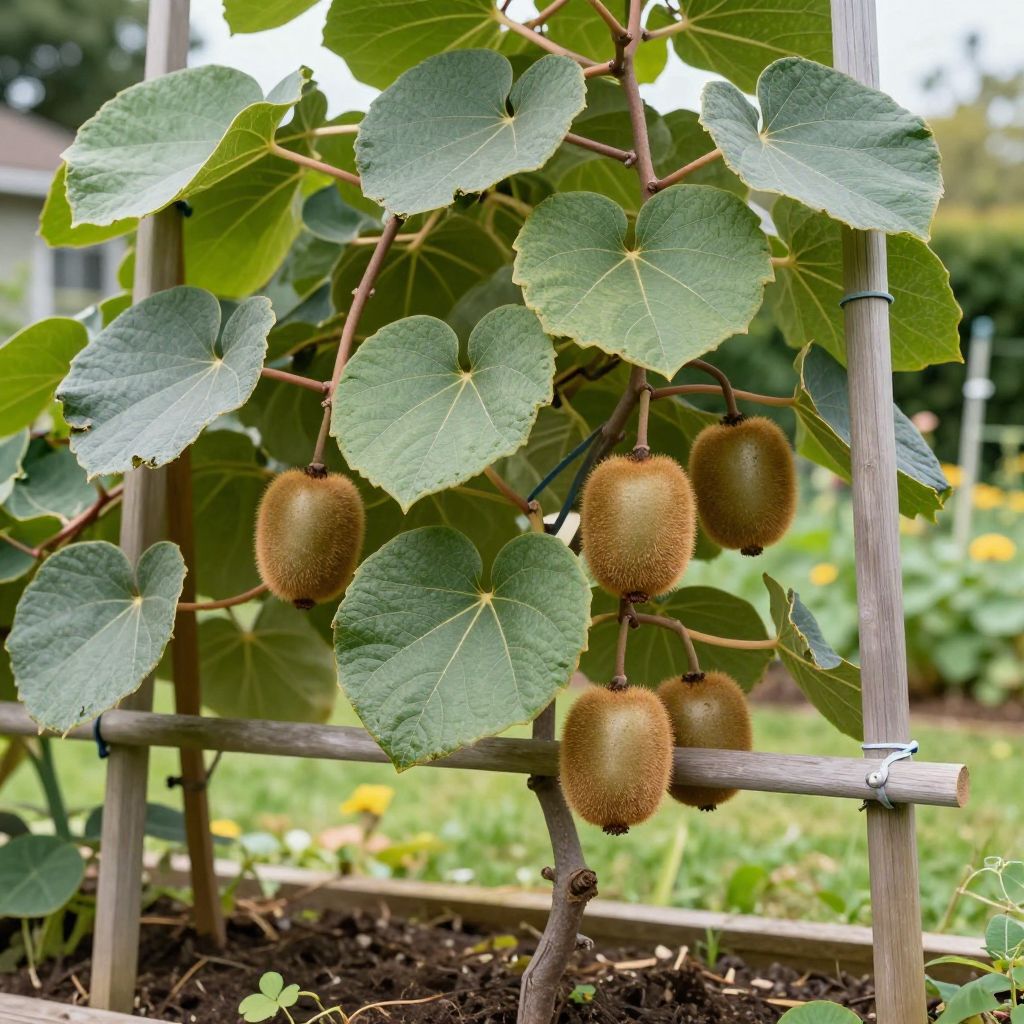
Do kiwis grow on trees? Not exactly. Kiwi fruit grows on vigorous woody vines, not true trees, and those vines need sturdy support to produce well. If you’re planning to grow kiwi at home, the key is understanding the plant’s climbing habit, pollination needs, and pruning requirements.
With the right site and care, kiwi vines can become productive, long-lived garden plants. They need space, sun, good drainage, and patience, but the payoff can be excellent if you match the variety to your climate and train it properly.
Do kiwis grow on trees?
No—kiwi fruit grows on fast-growing woody vines, usually trained on trellises, arbors, fences, or pergolas. The plant can look tree-like when mature and heavily pruned, but botanically it is a climbing vine that needs strong support to hold its weight and fruit.
What kiwi plants need to grow well
To grow kiwi successfully, give it full sun, fertile soil, consistent moisture, and excellent drainage. Kiwi vines dislike soggy roots, and they perform best where the root zone stays evenly moist but never waterlogged.
Sunlight and space
- Sun: Aim for at least 6 to 8 hours of direct sun daily.
- Space: Kiwi vines need room to spread, often much more than first-time growers expect.
- Support: Use a strong trellis, arbor, or wire system that can handle a mature vine.
In cooler climates, a sunny, sheltered spot helps the vine ripen fruit and protects young growth from harsh wind. In hot climates, some afternoon shade can reduce stress, especially for newly planted vines.
Soil and drainage
Kiwi grows best in loose, fertile soil that drains well. Heavy clay can work only if you improve it with organic matter and plant on a raised mound or bed to keep roots from sitting in wet soil.
- Work in compost before planting to improve soil structure.
- Avoid low spots where water collects after rain.
- Mulch to conserve moisture, but keep mulch a few inches away from the trunk.
How to plant kiwi vines
Plant kiwi in spring after the danger of hard frost has passed, or in fall in mild climates where roots can establish before winter. Choose a site carefully, because mature vines are difficult to move.
- Pick a sunny site with strong support already planned.
- Dig a hole about twice as wide as the root ball and no deeper.
- Mix compost into the removed soil if needed, especially in poor ground.
- Set the plant at the same depth it was growing in its container or nursery row.
- Backfill, water thoroughly, and mulch lightly.
- Train the main stem to the support as it grows.
Do not bury the crown too deeply. Deep planting can slow growth and increase rot problems, especially in wet soils.
Pollination: one vine or two?
Many kiwi varieties are dioecious, meaning male and female flowers are on separate plants. In that case, you need both a male and a female vine for fruit set. One male plant can usually pollinate several female plants if they bloom at the same time.
Why pollination matters
- Female vines produce fruit only if pollen reaches their flowers.
- Wind and insects both help with pollination, but bees are especially useful.
- If you have only one vine and it is a female type, you may get flowers but little or no fruit.
Some kiwi types are self-fertile, but even then, fruiting is often better with a pollinator nearby. If you’re buying plants, check whether the variety needs a male partner before you plant.
Training kiwi on a trellis
Kiwi vines need training from the start. A strong support system helps keep the vine organized, improves air circulation, and makes pruning and harvesting much easier.
Simple training approach
- Choose one main stem and tie it loosely to a stake or support.
- When it reaches the top wire or crossbeam, pinch or cut it to encourage side growth.
- Develop horizontal arms along the support structure.
- Each year, renew fruiting wood by pruning older growth and encouraging fresh shoots.
Use soft ties and check them regularly so they do not cut into the stem. A kiwi vine grows vigorously, and tight ties can damage bark quickly.
Pruning kiwi for fruit production
Pruning is one of the most important parts of kiwi care. Without it, the vine can become a tangled mass of leaves and stems with fewer fruits and poor airflow.
When to prune
Prune during dormancy in winter or very early spring, depending on your climate. Avoid heavy pruning during active growth unless you are removing broken, diseased, or badly misplaced stems.
What to remove
- Dead, damaged, or crossing stems
- Weak shoots that crowd the canopy
- Old fruiting wood that is no longer productive
- Excess growth that blocks light and airflow
Keep in mind that kiwi fruits on current-season growth that emerges from older wood. That means you want a balance: enough old structure to support new shoots, but not so much old growth that the vine becomes crowded.
Watering and feeding kiwi vines
Young kiwi vines need regular moisture while they establish, and mature vines still benefit from consistent watering during dry spells. The goal is steady growth, not wet feet.
Watering tips
- Water deeply rather than giving shallow, frequent splashes.
- Check soil moisture a few inches down before watering again.
- Increase watering during hot, windy weather and fruit development.
- Reduce watering if the soil stays wet after rain.
For feeding, compost and well-rotted organic matter are usually the safest starting point. If growth is weak or leaves are pale, a soil test is better than guessing with fertilizer. Too much nitrogen can produce lots of leafy growth but fewer flowers and fruit.
Common pests and diseases
Healthy kiwi vines can be fairly resilient, but problems are more likely when plants are crowded, overwatered, or poorly pruned. Good airflow and clean garden habits go a long way.
Pests to watch for
- Aphids: Cluster on soft new growth and can distort leaves.
- Spider mites: More common in hot, dry conditions.
- Scale insects: Can settle on stems and weaken the vine over time.
Diseases and stress problems
- Root rot: Often linked to poor drainage or overwatering.
- Leaf spots: More likely in crowded, wet foliage.
- Cold injury: Young growth can be damaged by late frosts in some climates.
To reduce problems, remove fallen leaves, prune for airflow, avoid overhead watering in the evening, and inspect the vine regularly. Catching issues early is much easier than fixing a neglected, overgrown plant.
Can you grow kiwi in containers?
Yes, but container growing is best for smaller spaces and more compact kiwi types. Even then, the container must be large, the support sturdy, and watering consistent because pots dry out faster than garden soil.
Container basics
- Use a large pot with drainage holes.
- Choose a rich, free-draining potting mix.
- Provide a trellis or frame for climbing.
- Watch moisture closely during warm weather.
Container-grown kiwi usually needs more frequent feeding and repotting than in-ground vines. If the plant becomes root-bound, growth and fruiting can decline.
Harvesting kiwi fruit
Kiwi fruit is usually harvested when it reaches full size but before it becomes fully soft on the vine. In many climates, fruit is picked in late season, then allowed to finish ripening off the plant.
How to tell when it is ready
- Fruit has reached mature size for the variety.
- Seeds inside are dark.
- The fruit separates more easily from the stem.
After harvest, kiwi fruit often ripens better indoors at room temperature. The exact timing depends on the variety and your local climate, so use fruit size and maturity rather than the calendar alone.
Common mistakes to avoid
- Planting kiwi in heavy, soggy soil without improving drainage
- Using a weak support that cannot handle mature vine weight
- Pruning too little and letting the vine become overcrowded
- Forgetting that many kiwi plants need both male and female vines
- Overfertilizing with nitrogen and getting leafy growth instead of fruit
Final thoughts
So, do kiwis grow on trees? No—they grow on vigorous climbing vines that need sun, support, pruning, and the right pollination setup. If you give them those basics, kiwi can become a rewarding fruiting plant in the home garden.
If you want to plan your planting next, start by checking your site for sun, drainage, and space, then choose a kiwi type suited to your climate and support system. For more fruit-growing guidance, look for related articles on trellis training and pruning fruit vines.