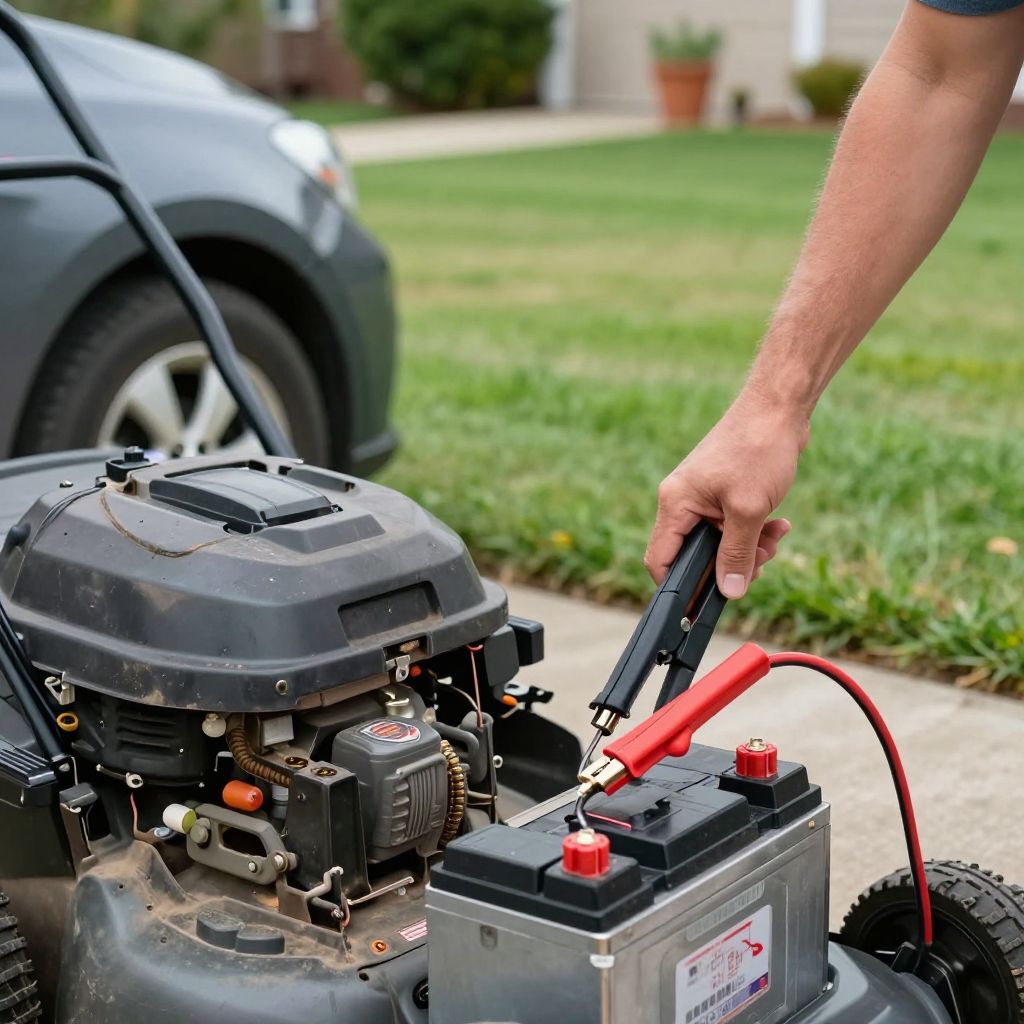
Can you jump a lawn mower battery with a car? Yes, in many cases you can, but only if you do it carefully and the mower uses the same kind of 12-volt battery system as the car. The key is to avoid overloading the mower’s electrical system and to connect the cables in the correct order.
This is a practical fix for a dead battery, not a cure for an underlying problem. If your mower battery keeps dying, the real issue may be age, corrosion, loose connections, a bad charging system, or storage conditions that drained it over winter.
Can You Jump A Lawn Mower Battery With A Car?
Yes, you can usually jump-start a lawn mower battery with a car if both are 12-volt systems and you use the car with the engine off. Connect the cables correctly, let the mower battery charge briefly, then start the mower. Never use a running car to jump a small mower battery, because the higher charging output can damage the mower’s electrical components.
Before You Try It: Check the Battery and Mower Type
Not every lawn mower should be jump-started the same way. Riding mowers, lawn tractors, and some zero-turn mowers often use 12-volt lead-acid batteries, while many push mowers have no battery at all unless they have electric start.
What to confirm first
- Battery voltage: Most jump-startable lawn mower batteries are 12 volts.
- Battery type: Usually lead-acid or sealed AGM; check the label if possible.
- Engine type: Gas-powered mowers with electric start are the usual candidates.
- Condition of the battery: A swollen, cracked, leaking, or frozen battery should not be jumped.
If the mower battery is visibly damaged, replace it instead of trying to revive it. A damaged battery can leak acid, overheat, or fail suddenly.
How to Jump a Lawn Mower Battery Safely
Use a car battery only as a power source, not as a running donor engine. The safest method is to keep the car off, set both machines in neutral or park, and make the final connection on the mower away from the battery if possible.
Step-by-step jump-start process
- Turn off the mower, remove the key, and make sure the blades are disengaged.
- Park the car close enough for the jumper cables to reach, but do not let the vehicles touch.
- Turn the car engine off.
- Attach the red clamp to the mower battery’s positive terminal.
- Attach the other red clamp to the car battery’s positive terminal.
- Attach the black clamp to the car battery’s negative terminal.
- Attach the last black clamp to a clean, unpainted metal part of the mower frame, away from the battery.
- Wait 1 to 3 minutes, then try starting the mower.
- Once the mower starts, remove the cables in reverse order.
Important: If you see sparks, smell burning, or notice the cables heating up, stop immediately and disconnect everything.
Why the Car Engine Should Stay Off
A car alternator can put out more current than a small mower battery or charging system is designed to handle. That extra power can stress fuses, wiring, relays, and the starter solenoid.
Keeping the car off still gives you enough battery power for a short jump, but it reduces the risk of electrical damage. For a small lawn mower battery, that is usually the better choice.
Common Mistakes to Avoid
Most jump-start problems come from simple setup errors. A careful connection matters more than how long you leave the cables attached.
- Do not jump a mower with a running car unless the mower manual specifically allows it.
- Do not reverse the positive and negative clamps.
- Do not connect the final black clamp directly to the mower battery post if you can avoid it.
- Do not jump a battery that is frozen, swollen, cracked, or leaking.
- Do not keep cranking the mower for long periods; short attempts are safer.
What If the Mower Still Won’t Start?
If the battery has enough charge but the mower still will not start, the problem may not be the battery at all. A weak starter, corroded terminals, bad ground connection, blown fuse, faulty safety switch, or fuel issue can all mimic a dead battery.
Quick troubleshooting checklist
- Check that the battery terminals are tight and clean.
- Look for white or green corrosion on the cable ends.
- Make sure the parking brake, seat switch, and blade switch are set correctly.
- Confirm the fuel is fresh and the fuel shutoff is open, if your mower has one.
- Listen for clicking, slow cranking, or no sound at all to narrow down the issue.
If the mower cranks slowly even after a jump, the battery may be too weak to hold a charge, or the starter circuit may have a resistance problem.
How to Reconnect and Recharge the Battery Properly
A jump-start is only meant to get the mower running. After that, the mower’s charging system should replenish the battery if it is working properly. Let the engine run long enough for the alternator or charging coil to do its job, but do not assume a short idle will fully recharge a deeply discharged battery.
Better long-term care for mower batteries
- Clean terminals and cable ends regularly.
- Keep the battery fully charged during storage.
- Use a battery maintainer if the mower sits for long periods.
- Store the mower in a dry place out of extreme heat and cold.
- Replace batteries that no longer hold a charge reliably.
Cold weather is especially hard on mower batteries. If your mower is stored through winter, a maintained charge can make spring startup much easier.
When to Replace Instead of Jumping
Jumping a mower battery makes sense for a one-time discharge, but not for a battery that is worn out. Lead-acid batteries naturally lose capacity over time, especially if they are repeatedly drained or stored empty.
Consider replacement if the battery:
- Is several seasons old and weakens quickly after charging
- Needs frequent jump-starts
- Shows corrosion that returns quickly after cleaning
- Will not hold a charge after normal use
- Looks swollen, cracked, or damaged
A new battery is often the simplest fix when the old one can no longer support reliable starting.
Safety Tips for Working Around Mowers and Batteries
Lawn mower batteries are small, but they can still produce a strong spark or release flammable gas. Work in a well-ventilated area and keep metal tools away from the terminals when possible.
- Wear eye protection if you have it.
- Keep hands and tools dry.
- Avoid smoking or open flames near the battery.
- Remove jewelry that could accidentally bridge terminals.
- Follow the mower manufacturer’s manual if it gives specific jump-start instructions.
Final Takeaway
Yes, you can jump a lawn mower battery with a car, and it is often a quick way to get back to mowing. Just keep the car engine off, connect the cables in the right order, and stop if the battery looks damaged or the mower shows signs of a deeper electrical problem.
If you want to keep your mower starting reliably, it also helps to understand battery care and engine maintenance. You may also find these guides useful: what kind of oil to use for a lawn mower and what type of oil a lawn mower takes.