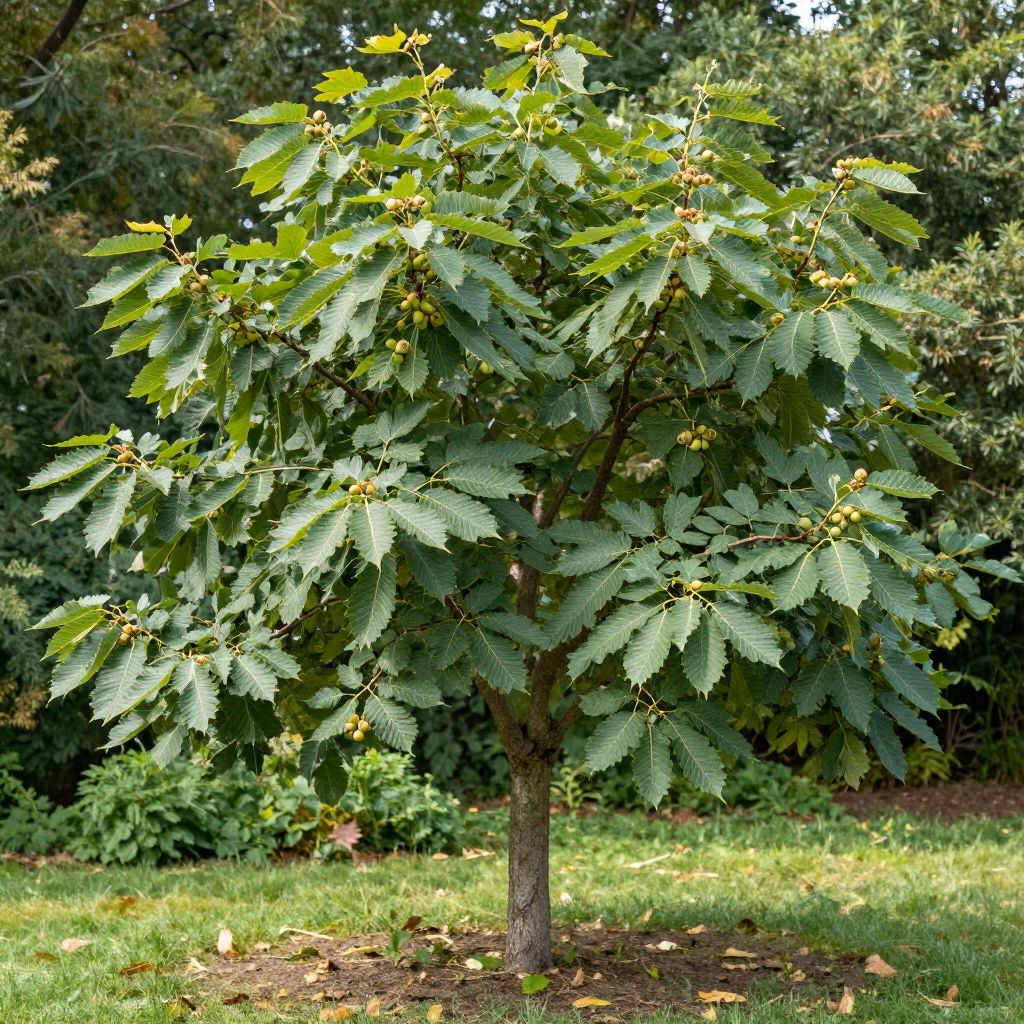
What does a hickory tree look like if you’re trying to identify one in your yard or a nearby woodland? Hickories are tall, stately native trees with compound leaves, ridged bark, and nuts enclosed in a husk. Once you know the key features, they’re fairly easy to recognize in the right season.
They can be confused with walnuts, ash, or pecan trees, so it helps to look at several traits together: leaves, bark, buds, fruit, and overall shape. This guide will help you identify a hickory tree and understand the growing conditions it prefers.
What does a hickory tree look like?
A hickory tree is usually a large, upright tree with a straight trunk, an open crown, and compound leaves made up of several leaflets. The bark is often gray and deeply ridged or shaggy, and the nuts grow inside a thick husk that splits as they mature. In winter, long pointed buds help separate hickories from many other trees.
Key features of hickory tree identification
Leaves
Hickory leaves are compound, meaning each leaf is made of multiple leaflets attached to one stem. Most hickories have 5 to 9 leaflets, though some species can show a little variation.
- Leaflets are usually lance-shaped and pointed at the tip.
- Edges may be finely toothed, depending on the species.
- The leaf arrangement is alternate along the twig, not opposite.
One common clue is that hickory leaves often look sturdy and evenly spaced rather than delicate or feathery.
Bark
Young hickory bark is relatively smooth, but mature trees develop rough, furrowed bark. Some species, such as shagbark hickory, have long loose strips that peel away from the trunk, giving the tree a shaggy appearance.
- Shagbark hickory: long, curling strips of bark that hang away from the trunk.
- Shellbark hickory: similar, but often with even larger bark plates.
- Other hickories may have tight, deeply ridged bark instead of shaggy bark.
Bark alone is not enough for a positive ID, but it is one of the easiest features to spot from a distance.
Twigs and buds
In winter, hickory twigs are helpful for identification. They are usually stout, and the buds are often large, pointed, and covered with overlapping scales.
Hickory buds can look almost oversized compared with the twig, which is a useful clue when leaves are absent.
Fruit and nuts
Hickories produce round or oval nuts enclosed in a green husk. As the fruit matures, the husk dries and splits into sections, revealing the hard shell inside.
- Some species have thick husks that split cleanly into four sections.
- The shell inside may be hard and smooth or slightly ridged.
- The nut is usually edible, though quality varies by species.
If you see nuts on the ground with a splitting husk, that is one of the strongest signs you are looking at a hickory.
How to tell hickory apart from similar trees
Hickory vs. walnut
Walnut trees also have compound leaves, but they usually have more leaflets and a stronger, more aromatic smell when crushed. Walnut bark is typically more deeply furrowed and less shaggy than shagbark hickory.
Hickory vs. ash
Ash trees have opposite branching, while hickories have alternate branching. That branching pattern is one of the quickest ways to separate them. Ash leaves are also compound, but the overall look is often lighter and more open.
Hickory vs. pecan
Pecan is a type of hickory, so the comparison can be confusing. Pecan trees usually have more leaflets, narrower leaflets, and nuts with thinner shells. They also tend to grow best in warmer climates than many other hickories.
Where hickory trees grow best
Hickories are native to North America and are usually found in woodlands, mixed forests, and well-drained sites. They prefer full sun to light shade and do best in soil that is deep, fertile, and not constantly wet.
- Sunlight: full sun is best for strong growth and nut production.
- Soil: loamy soil is ideal, but hickories can adapt if drainage is good.
- Drainage: avoid sites that stay soggy after rain.
- Space: mature trees need plenty of room for roots and canopy spread.
If you are planting a hickory, choose a site carefully. These are long-lived trees and do not transplant well once they are large.
How to plant a hickory tree
If you want to grow hickory in the landscape, start with a young tree from a reputable nursery rather than trying to move a wild sapling from a difficult site. Hickories develop a strong taproot, so early planting matters.
- Pick a site with full sun and well-drained soil.
- Dig a hole as deep as the root ball and wider than the root ball.
- Set the tree so the root flare sits at or slightly above soil level.
- Backfill with the native soil you removed, breaking up clods.
- Water thoroughly to settle the soil.
- Mulch with 2 to 4 inches of organic mulch, keeping it away from the trunk.
Avoid planting too deep. Burying the root flare is a common mistake that can weaken the tree over time.
Watering and care for young hickory trees
Young hickories need regular moisture while they establish, but they should not sit in wet soil. Water deeply when the top layer of soil begins to dry, then let the soil drain before watering again.
As the tree matures, it becomes more drought-tolerant, but long dry spells can still reduce growth and nut set. In hot, dry weather, check the soil rather than relying on a fixed schedule.
Mulch and soil care
Mulch helps conserve moisture, moderate soil temperature, and reduce competition from grass. Keep mulch in a wide ring around the tree, but do not pile it against the trunk.
- Use wood chips, shredded bark, or leaf mulch.
- Refresh mulch as it breaks down.
- Avoid heavy fertilizing unless a soil test shows a clear need.
Hickories usually do not need much feeding in average garden soil. If growth is weak, a soil test is more useful than guessing with fertilizer.
Pruning hickory trees
Hickories generally need only light pruning when young to remove damaged, crossing, or poorly placed branches. Once established, they are best left mostly alone unless there is a safety issue.
- Prune in late winter or during dormancy if possible.
- Remove dead, broken, or rubbing branches first.
- Keep the central structure balanced and open.
Do not remove large limbs unnecessarily. Hickories heal slowly compared with smaller ornamental trees, and heavy pruning can stress them.
Common pests and diseases
Healthy hickories are fairly resilient, but they can still face insect and disease problems, especially when stressed by poor soil, drought, or injury.
Possible pests
- Hickory bark beetles
- Caterpillars and leaf-feeding insects
- Nut weevils in some areas
Possible diseases
- Leaf spots
- Cankers
- Root problems in poorly drained soil
The best prevention is good site selection. A hickory planted in well-drained soil with enough sun and space is far less likely to struggle.
Propagation and harvesting
Hickories can be grown from nuts, but germination is slow and uneven. Fresh nuts often need cold stratification, and seedlings may take years before they become substantial trees.
If you collect nuts for planting, choose fully mature nuts that have fallen naturally. Remove the husk, keep the seed from drying out completely, and follow local guidance for cold treatment based on your climate and species.
For harvesting edible nuts, wait until the husks split and the nuts begin to drop. Gather them promptly before wildlife gets to them.
Landscape uses for hickory trees
Hickories make excellent shade trees in large yards, parks, and naturalized landscapes. Their strong wood, attractive bark, and wildlife value make them useful where space is available.
- Best for large properties, not tight urban spaces.
- Useful as specimen trees or woodland edges.
- Provide food and cover for birds and wildlife.
Because they grow large and long-lived, hickories are a commitment. Make sure overhead wires, buildings, and sidewalks are well out of the way before planting.
Quick identification checklist
If you are still wondering what does a hickory tree look like, use this simple checklist in the field:
- Large tree with a straight trunk
- Alternate branching
- Compound leaves with 5 to 9 leaflets
- Gray bark that is ridged or shaggy
- Large pointed winter buds
- Nuts enclosed in a splitting husk
If several of these traits match, you are likely looking at a hickory rather than a lookalike tree.
Conclusion
To identify a hickory tree, look for compound leaves, rough or shaggy bark, pointed buds, and nuts in a splitting husk. Once you know these features, you can spot hickories more confidently in any season. If you plan to plant one, choose a sunny, well-drained site and give it room to mature.
For more tree ID help, you may also want to read about tree bark identification and how to plant native trees.