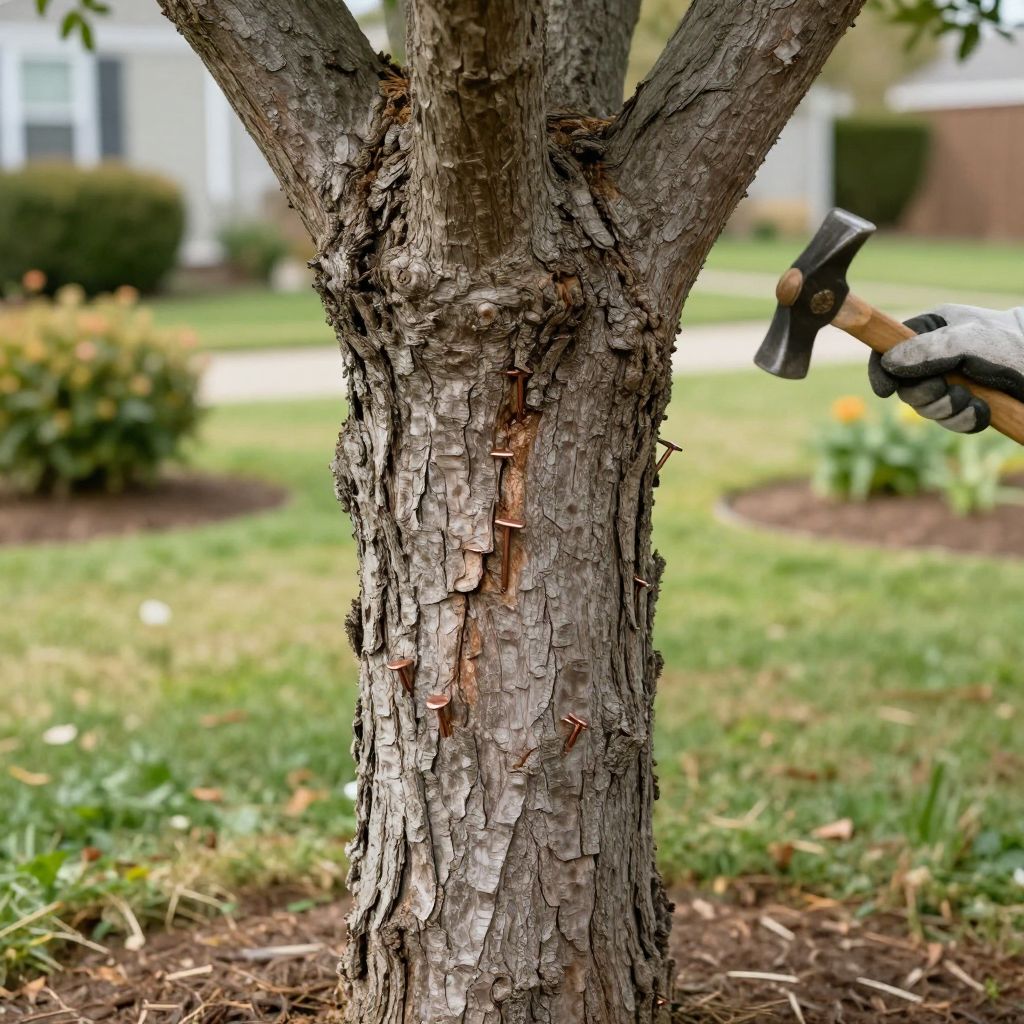
Do copper nails kill trees? It’s a common garden myth, and the short answer is usually no. A copper nail by itself rarely kills a healthy tree, but it can wound bark, invite decay, and stress a tree that is already struggling.
If you’re trying to manage a stump, stop a tree from growing, or deal with an unwanted root problem, there are safer and more effective methods. The right approach depends on the tree’s size, species, age, and whether it is living, dying, or already cut down.
Do Copper Nails Kill Trees?
Usually not. Driving a copper nail into a tree does not reliably kill it, because trees are large, resilient organisms that can compartmentalize small wounds. However, repeated nailing, deep damage, or use on a stressed tree can create entry points for pests and disease and may contribute to decline over time.
Why the Copper Nail Myth Persists
The idea likely comes from copper’s known toxicity to plants in some forms and concentrations. Copper is used in certain fungicides and root barriers, but a single nail does not release enough copper into a tree to act like a lethal treatment.
In practice, the bigger issue is not the metal itself but the wound. A nail punctures bark and cambium, the living tissue that moves water and nutrients. That injury can be minor, but it is still unnecessary damage.
What happens when a tree is nailed
- The bark is pierced, which can open the door to rot organisms.
- The cambium may be damaged, especially if the nail is large or driven deeply.
- The tree may form callus tissue around the wound, but the scar remains.
- Multiple nails can weaken a branch or trunk over time.
When Copper Nails Can Be a Problem
Even if one nail does not kill a tree, it can still be harmful in the wrong situation. Young trees, thin-barked species, and already stressed trees are more vulnerable than mature, vigorous ones.
Higher-risk situations
- Young trees with thin bark and limited reserves
- Recently transplanted trees that are already under stress
- Trees with cankers, rot, or insect damage
- Repeated nailing in the same trunk or branch
- Large nails or bolts that create deeper structural injury
If a tree is already declining from drought, poor drainage, root damage, girdling roots, compaction, or disease, adding a nail can make recovery harder. In that sense, the nail is not usually the cause of death, but it can be part of a chain of stress.
What To Do Instead of Using Copper Nails
If your goal is to remove a tree, control a stump, or stop regrowth, there are better methods than hammering in metal. Choose the method that fits the task and follow local rules, especially for herbicide use and tree removal.
If you want to remove a living tree
- Confirm that removal is necessary and legal for your area.
- Identify nearby utilities, fences, structures, and overhead lines.
- Hire a certified arborist for large trees or risky locations.
- Use proper cutting and stump management methods rather than random trunk damage.
If you want to stop stump sprouting
Some trees resprout vigorously from the stump or roots after cutting. In those cases, the usual approach is to cut the stump cleanly and manage regrowth with a method suited to the species and your local regulations.
- Cut the stump as low as practical after felling.
- Monitor for new shoots from the stump or roots.
- Remove shoots promptly if you are using a non-chemical approach.
- For persistent species, consult a local extension service or arborist for the most effective control method.
If you are trying to protect a tree
Sometimes people drive nails into trees to hang signs, lights, birdhouses, or garden decorations. That is where the damage is most avoidable. Use straps, non-invasive hangers, or freestanding supports instead.
- Use soft tree ties or wide straps that do not cut into bark.
- Attach items to posts, not trunks, whenever possible.
- Keep hardware out of the trunk and major scaffold branches.
- Check attachments yearly so they do not tighten as the tree grows.
How Trees Respond to Wounds
Trees do not heal exactly like animals. They compartmentalize damage by sealing off injured tissue and growing around it. That means a small wound may remain as a scar, but the tree can often continue growing if it is otherwise healthy.
Still, every wound is a tradeoff. The tree uses energy to defend itself, and repeated injuries reduce its ability to resist drought, insects, and disease.
Signs a tree is stressed after damage
- Wilting or early leaf drop
- Dieback in twigs or branch tips
- Cracking, oozing, or sunken bark around the wound
- Mushrooms or soft decay near the trunk base
- Increased insect activity around the injury
Safer Ways To Manage Tree Problems
If you are dealing with an unwanted tree or stump, the best solution depends on whether you want removal, containment, or simple cleanup. A thoughtful plan is usually faster and less damaging than experimenting with folk remedies.
For unwanted seedlings or saplings
- Pull small seedlings when the soil is moist.
- Cut saplings at ground level and monitor for resprouting.
- Mulch garden beds to reduce new seedling establishment.
- Keep the area weeded so you can spot regrowth early.
For stumps in a landscape bed
- Grind the stump if you want faster removal.
- Cover the area with mulch and replant only after the root zone is stable.
- Avoid burying the stump under soil alone, which often leads to settling and decay issues.
- Watch for roots that may continue to sprout from the edges.
For trees near lawns or hardscape
Root problems are often mistaken for trunk problems. If a tree is pushing up pavement, competing with turf, or dropping branches, the answer is not a nail. Improve growing conditions, prune correctly, or remove the tree if it is unsafe.
Common Mistakes Gardeners Make
When people ask, “Do copper nails kill trees?” they are often looking for a simple fix. The problem is that simple fixes can create bigger issues later.
- Using nails as a removal method instead of proper cutting or stump control
- Driving nails into healthy trunks for convenience or decoration
- Assuming copper will act like a poison in nail form
- Ignoring tree stress from drought, poor soil, or root damage
- Leaving metal in place where it can interfere with future pruning or storm damage repair
How to Care for a Tree That Has Been Nailed
If a tree already has a nail in it, don’t panic. One small wound is not automatically fatal, but you should reduce further stress and monitor the area.
- Do not add more nails or hardware.
- If the nail is shallow and easy to remove, consider having it removed carefully, especially on younger trees.
- Do not enlarge the wound trying to “clean it out.”
- Water during dry spells if the species and season call for it.
- Mulch the root zone with a 2–4 inch layer, keeping mulch away from the trunk.
- Watch for cracking, decay, or dieback over the following season.
If the wound is large, near the base, or on a valuable tree, an arborist can assess whether the tree needs pruning, cabling, or closer monitoring.
Best Practices for Healthy Trees
The best way to avoid tree decline is to keep trees vigorous in the first place. Healthy trees tolerate minor injury much better than stressed ones.
- Plant the right tree in the right place.
- Give roots room to spread.
- Use well-drained soil suited to the species.
- Water deeply during establishment and drought, based on local weather and soil moisture.
- Prune with clean tools and avoid unnecessary trunk wounds.
- Inspect regularly for pests, disease, and structural problems.
For newly planted trees, especially, steady care matters more than any quick fix. A tree with a healthy root system, proper mulching, and good structure is far less likely to suffer from minor damage.
Conclusion: Skip the Nail, Choose the Right Solution
So, do copper nails kill trees? Not reliably, and not in the way many people assume. They are more likely to wound a tree than to solve a tree problem. If you need to remove, control, or protect a tree, use a method matched to the situation and your local conditions.
Before you reach for a nail, inspect the tree, identify the real problem, and choose a safer fix. If you want more practical tree care guidance, look for reliable local arborist advice and tree maintenance resources from your extension service or nursery.