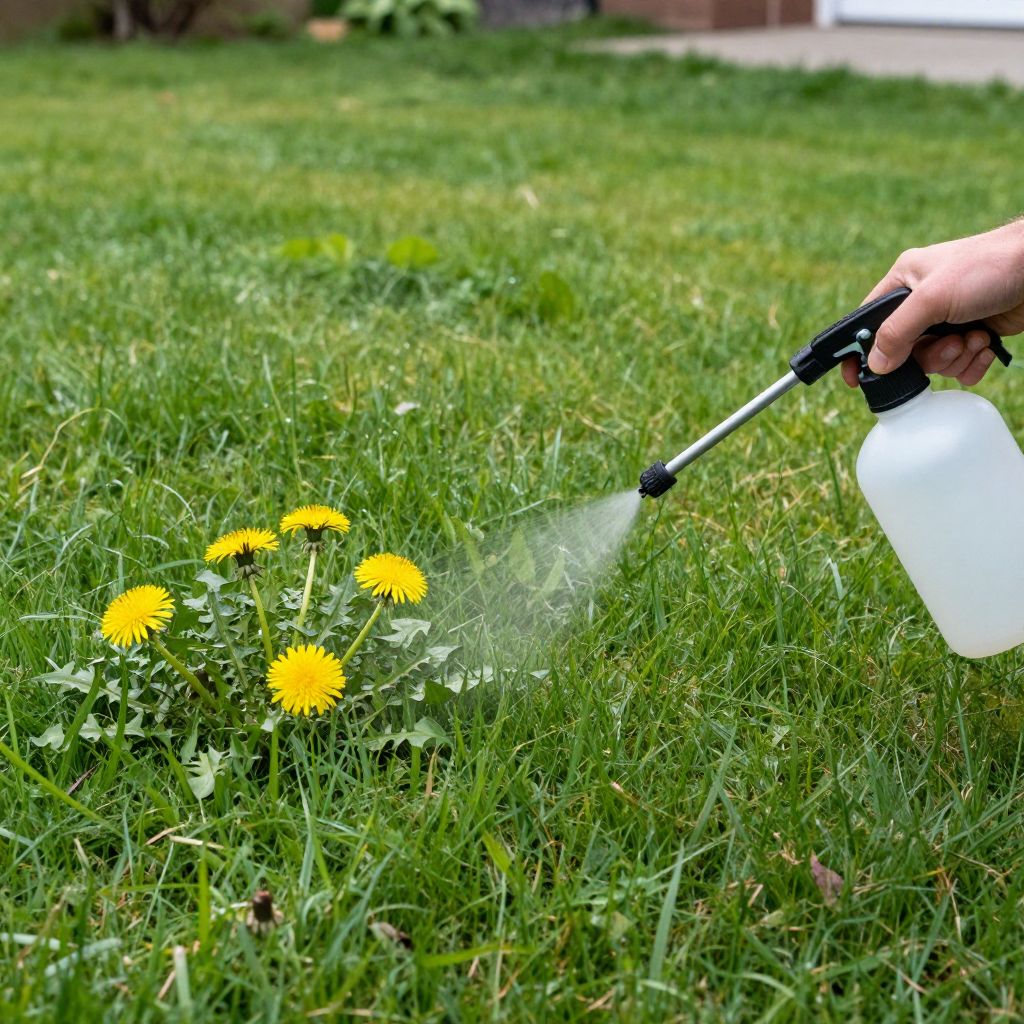
What kills dandelions but not grass? The safest answer is a selective broadleaf herbicide, because dandelions are broadleaf weeds while lawn grasses are narrow-leaved grasses. Used correctly, these products target the weed without harming most turfgrass. The key is choosing the right product, applying it at the right time, and keeping your lawn healthy so dandelions have fewer chances to return.
If you prefer non-chemical control, you can also remove dandelions by hand or weaken them with repeated mowing and spot treatment. The best method depends on how many weeds you have, your grass type, and how much time you want to spend maintaining the lawn.
What kills dandelions but not grass?
Selective broadleaf herbicides kill dandelions without damaging most lawn grasses because they are designed to affect broadleaf plants, not grasses. Common active ingredients include 2,4-D, dicamba, MCPP/Mecoprop, and triclopyr. Always read the label carefully, because not every product is safe for every grass type or lawn situation.
Why dandelions are easier to target than grass
Dandelions have broad, flat leaves and a deep taproot, while turfgrass has narrow blades and a different growth pattern. That difference lets many herbicides target broadleaf weeds selectively. It also means dandelions can survive if you only remove the top growth and leave the root behind.
What makes dandelions stubborn
- Deep taproots store energy below ground.
- They regrow if the crown or root is left intact.
- They spread easily by seed, especially in thin lawns.
- They thrive where soil is compacted or turf is weak.
Best ways to kill dandelions without harming grass
For most lawns, the most effective option is a selective broadleaf weed killer labeled for lawn use. If you want to avoid herbicides, hand-pulling with the root intact works well on small infestations, especially after rain or watering when the soil is moist.
1. Selective broadleaf herbicides
These are the standard answer to “what kills dandelions but not grass.” They are sold as liquid sprays or granules, and many are designed for spot treatment in lawns. They work best when dandelions are actively growing and not stressed by drought or extreme heat.
Important: not all turfgrasses tolerate the same products. Some herbicides can injure or discolor certain grasses, especially warm-season turf, newly seeded lawns, or stressed turf. The label is the final authority.
2. Hand-pulling or digging
Use a dandelion weeder, hori-hori, or narrow trowel to remove the entire root. This is most effective when the ground is damp and the plant is young. If the root snaps, return to the spot and dig again before the plant flowers and sets seed.
3. Repeated mowing
Mowing does not kill established dandelions quickly, but it helps prevent flowering and seed production. Keep your mower blade sharp and mow at the correct height for your grass type. Cutting too short weakens turf and gives dandelions more room to spread.
How to apply a lawn weed killer safely and effectively
Read the product label before you spray. The label tells you which grass species are safe, what weeds are controlled, how to mix the product, and when not to apply it. Spot-treating individual dandelions is usually better than broadcasting herbicide over the whole lawn.
- Choose a product labeled for dandelions and lawn grass.
- Check that your grass type is listed as tolerant.
- Apply when dandelions are actively growing, not drought-stressed.
- Spray on a calm day to avoid drift onto flowers, shrubs, or vegetables.
- Keep children and pets off the area for the time stated on the label.
- Recheck treated spots after 1 to 3 weeks and retreat only if the label allows it.
Weather matters
Herbicides usually work best in mild weather, when weeds are actively growing and rain is not expected right away. Avoid applying during heat stress, drought, or windy conditions. If the lawn is wet from dew or rain, wait until the foliage dries unless the label says otherwise.
When to treat dandelions for the best results
The most effective time is when dandelions are young and actively growing, often in spring or fall depending on your climate. Fall treatment can be especially useful because dandelions move energy into the root as they prepare for winter, which can improve control.
Seasonal timing tips
- Spring: good for spot treatment before flowering.
- Early summer: treat young plants before seed heads form.
- Fall: often excellent for root-killing control.
- Winter dormancy: herbicides are less effective when growth slows.
Common mistakes that make dandelion control fail
Many lawn weed problems come from timing or lawn stress, not from the product itself. If dandelions keep returning, it usually means the lawn needs better coverage, better timing, or better cultural care.
- Spraying too late: large, mature dandelions are harder to kill.
- Not reading the label: some products are not safe for all grasses.
- Underapplying or overapplying: both can reduce control or damage turf.
- Mowing too soon after treatment: this can reduce herbicide uptake.
- Ignoring lawn health: thin turf invites new weeds.
- Pulling only the top: the taproot can regrow.
How to keep dandelions from coming back
Killing existing weeds is only part of the job. A thick, vigorous lawn is the best long-term defense against dandelions because it shades the soil, crowds out seedlings, and competes for water and nutrients.
Build a stronger lawn
- Mow at the recommended height for your grass species.
- Water deeply but not constantly, so roots grow deeper.
- Aerate compacted soil if your lawn has heavy foot traffic.
- Overseed thin areas where dandelions keep appearing.
- Topdress or improve soil only if your lawn needs it.
- Remove seed heads before they fluff and spread.
Fix the conditions dandelions love
Dandelions often show up where grass is struggling. Compacted soil, poor drainage, low fertility, and bare patches all make it easier for weeds to establish. If you correct those issues, you reduce future outbreaks without relying only on herbicides.
What if you want a non-chemical option?
If you prefer not to use herbicides, hand removal is the most reliable selective method. It takes more effort, but it avoids spray drift and works well in small lawns or around mixed plantings where you want to protect nearby ornamentals.
Best non-chemical approach
- Water the area lightly or pull after rain.
- Use a weeding tool to loosen the soil around the taproot.
- Lift the entire root, not just the leaves.
- Fill the hole with soil if needed and overseed bare spots.
- Repeat before plants flower again.
Troubleshooting: why dandelions survive treatment
If a treated dandelion is still alive, the plant may have been too mature, the application may have missed the crown, or the weather may have reduced effectiveness. Some weeds need a second treatment, but only if the label allows repeat applications.
Signs you need a different approach
- The leaves twist or yellow slightly but recover.
- Only the top growth died, but the crown resprouted.
- New seedlings keep appearing in thin turf.
- The lawn is compacted, patchy, or mowed too short.
In those cases, combine spot treatment with better mowing, overseeding, and soil improvement. That approach usually works better than repeated spraying alone.
Final takeaway
If you want to know what kills dandelions but not grass, start with a selective broadleaf herbicide labeled for your turf type, or remove the plants by hand with the root intact. Then strengthen the lawn so dandelions have fewer openings to return. For more lawn care help, look for practical guides on mowing height, overseeding, and soil improvement.