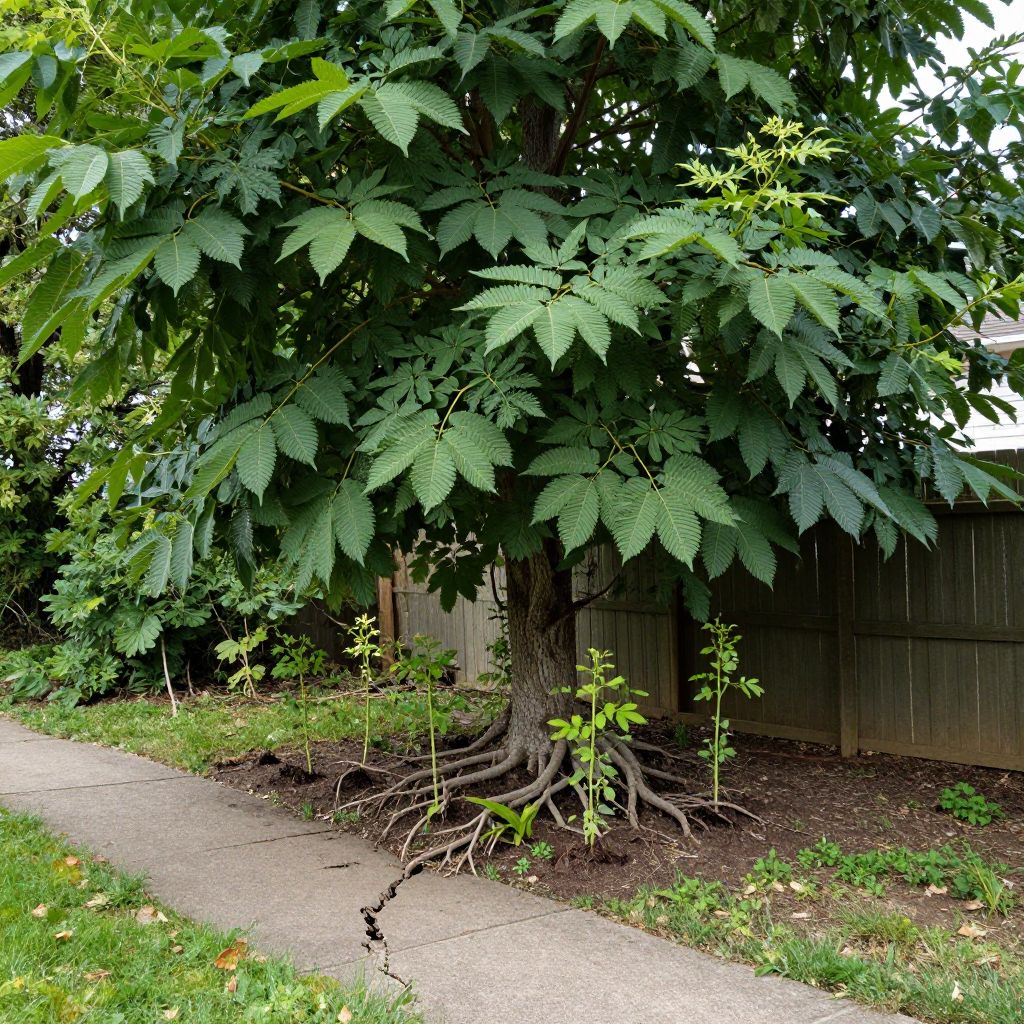
Why is the tree of heaven a problem? If you’ve spotted this fast-growing tree on your property, the short answer is that it spreads aggressively, resprouts after cutting, and can crowd out other plants. It also produces abundant seed and can be difficult to remove once established.
For home gardeners, the bigger issue is that Ailanthus altissima is not just a nuisance tree—it can become a long-term maintenance problem in beds, fences, lawns, and natural areas. The good news is that with correct identification and a persistent removal plan, you can reduce it and protect nearby plantings.
Why is the tree of heaven a problem?
The tree of heaven is a problem because it grows quickly, spreads by seed and root suckers, and rebounds strongly after cutting or damage. It can form dense thickets, shade out desirable plants, and invade cracks, edges, and neglected spaces. In many landscapes, it becomes harder to control the longer it is left alone.
What makes tree of heaven so invasive?
Tree of heaven is especially troublesome because it combines rapid growth with aggressive reproduction. A single tree can produce many seeds, and its roots can send up new shoots well away from the trunk. That means one plant can turn into a patch of trees if you only remove the visible stem.
Common traits that help it spread
- Fast growth: It can quickly outcompete slower-growing shrubs and young trees.
- Seed production: Female trees can drop large clusters of winged seeds that travel on wind.
- Root suckering: Cutting or damaging the trunk often triggers new shoots from the roots.
- Tolerance of poor sites: It handles compacted, dry, and disturbed soils better than many ornamentals.
- Persistence: Even small stumps and root pieces may resprout if not managed properly.
How to identify tree of heaven before it spreads
Correct identification matters because young tree of heaven is sometimes mistaken for sumac, walnut, or ash. Look for long compound leaves, smooth gray bark on young stems, and a strong odor when leaves are crushed. Mature trees often have large clusters of seed structures that remain visible into fall and winter.
Signs to look for
- Leaves made up of many leaflets, often with a single pair of basal glands near the leaflet base
- Leaflets with smooth edges except for one or more small teeth near the base
- Rapid upright growth in disturbed areas, along fences, or near foundations
- Dense patches of seedlings or root sprouts around a parent tree
If you are unsure, compare the plant with another tree before cutting. Misidentification can lead to removing the wrong tree or choosing the wrong control method.
Where tree of heaven causes the most trouble in gardens
This tree often becomes a problem in places where the soil has been disturbed or where regular maintenance is inconsistent. It is especially common along property lines, vacant lots, alleyways, roadsides, and the edges of gardens where mowing or pruning is irregular.
Typical problem areas
- Fence lines and hedges
- Mulched beds with gaps or thin groundcover
- Brambles, brushy corners, and neglected borders
- Cracks in pavement, patios, and retaining walls
- Under utility lines or near structures where pruning is frequent
In a home landscape, the biggest risk is not just the tree itself, but the new shoots it creates after removal. That is why simple cutting alone usually fails.
How to remove tree of heaven safely and effectively
Successful control usually takes more than one season. The best approach depends on tree size, location, and whether you can tolerate temporary dieback around the stump. For many gardeners, a combination of cutting, repeated follow-up, and careful treatment of resprouts is the most realistic path.
Step-by-step removal approach
- Confirm the plant. Make sure it is tree of heaven before you start.
- Choose the right timing. Late summer through early fall is often effective because the plant is moving resources to the roots.
- Cut the trunk low. Remove stems close to the ground with clean, sturdy tools.
- Monitor for regrowth. Expect new shoots from the stump or nearby roots.
- Remove sprouts promptly. Repeated cutting weakens the plant over time.
- Dispose of debris carefully. Do not leave live cuttings where they can root or be moved to another site.
Why cutting alone is not enough
Tree of heaven often responds to cutting by producing multiple vigorous shoots. If you only mow or saw it down once, you may end up with more stems than before. Persistence matters more than speed with this species.
When to use pruning, cutting, or stump treatment
For small seedlings, hand-pulling can work if the soil is moist and the roots come out cleanly. For larger stems, cutting is usually necessary. In some situations, gardeners use targeted stump treatment after cutting, but this should be done carefully and according to local regulations and label directions if a product is involved.
Practical decision guide
- Seedlings: Pull when soil is damp and the root is small enough to remove fully.
- Young saplings: Cut low and watch closely for resprouting.
- Mature trees: Plan for repeated follow-up and consider professional help if the tree is large, near structures, or in a difficult location.
If the tree is close to a house, fence, or utility line, avoid risky cutting. Large stems can fall unpredictably, and root disturbance can affect nearby plants and hardscape.
Common mistakes gardeners make
Many control failures happen because the plant is treated like an ordinary volunteer tree. Tree of heaven is tougher than that, so a few common mistakes can keep the problem going for years.
- Leaving stumps untreated: This often leads to strong resprouting.
- Ignoring root suckers: New shoots may appear several feet from the original tree.
- Letting seed heads mature: This allows the problem to spread to other areas.
- Using shallow mulch only: Mulch can suppress seedlings, but it will not stop established roots.
- Stopping too soon: One season of follow-up is often not enough.
How to prevent tree of heaven from returning
Prevention is mostly about vigilance. Once you remove the main tree, inspect the area regularly for seedlings and suckers. The earlier you catch regrowth, the easier it is to control without major disruption to surrounding plants.
Good prevention habits
- Walk the area every few weeks during the growing season.
- Pull or cut new sprouts while they are small.
- Keep borders, fence lines, and neglected corners mowed or trimmed.
- Replace open soil with dense, well-maintained plantings where appropriate.
- Watch for seedlings after wind events, especially near mature trees.
In garden beds, a thick layer of organic mulch can help reduce new seedlings, but it should be part of a broader plan, not the only defense.
How tree of heaven affects nearby plants and the landscape
Because it grows quickly and forms dense stands, tree of heaven can reduce light, water, and root space for nearby ornamentals and young trees. That can make beds look thin, stressed, or uneven. In mixed plantings, it often becomes the dominant plant unless it is managed early.
Landscape impacts to watch for
- Shading of sun-loving perennials and shrubs
- Competition with young fruit trees or native trees
- Frequent root sprouts in lawns and borders
- Difficulty maintaining tidy edges near hardscape
If you are trying to restore a bed after removal, replant with species suited to your light, soil, and moisture conditions. Strong, well-matched plants are less likely to be overwhelmed by future seedlings.
Should you keep tree of heaven as a shade tree?
In most home gardens, the answer is no. Even though it grows fast and can provide quick shade, the maintenance burden usually outweighs the benefit. Its tendency to spread, resprout, and crowd out other plants makes it a poor long-term choice for most residential landscapes.
If a tree is already established and removal is not immediate, at minimum prevent seed production and manage suckers before they become a larger infestation. That is especially important near gardens, paths, and neighboring properties.
Conclusion: what to do next
If you’re asking why is the tree of heaven a problem, the key reason is its persistence: it spreads fast, resprouts aggressively, and can take over neglected or disturbed areas. Start by identifying it correctly, then remove it with a plan for follow-up, not just a one-time cut.
For more practical help with difficult landscape trees and woody weeds, you may also want to read about how to remove invasive trees safely and using mulch for long-term weed control in garden beds.