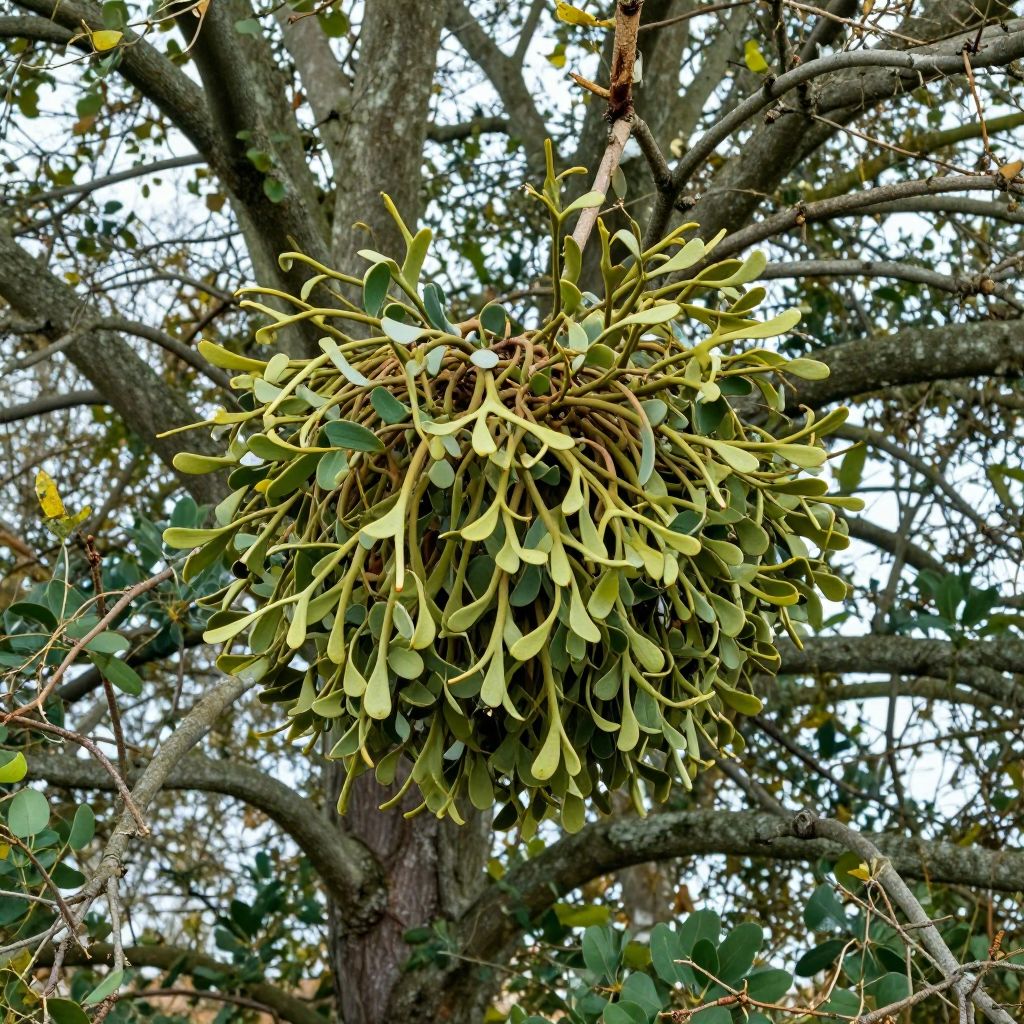
Seeing mistletoe in a tree can be surprising, especially if the plant seems to appear “out of nowhere.” If you’re wondering what causes mistletoe in trees, the short answer is that birds spread the seeds, and the young plant then establishes itself on a suitable host branch.
Once it’s attached, mistletoe taps into the tree for water and minerals. That means the real issue is not just the plant itself, but the conditions that let it spread and the stress it can create over time.
What causes mistletoe in trees?
Mistletoe appears when birds eat its berries and later deposit the sticky seeds onto branches. The seed germinates, anchors to the bark, and sends root-like structures into the tree to draw water and nutrients. It spreads most easily in trees that are mature, stressed, or growing in areas where birds frequently perch.
How mistletoe gets started
Mistletoe is a parasitic or hemiparasitic plant, depending on the species, meaning it can make some of its own food but still relies on the host tree for water and minerals. That’s why you usually find it attached high in the canopy, where birds have access and branches offer a foothold.
Birds are the main spreaders
The sticky seeds are designed to cling to bark, feathers, or beak surfaces. Birds often wipe their beaks on branches after feeding, which helps place the seed exactly where it can germinate.
- Birds eat the berries and move from tree to tree.
- Seeds stick to bark after being dropped or wiped off.
- Warm, moist conditions help the seed start growing.
- Once established, the plant slowly expands within the branch.
Not every tree is equally vulnerable
Mistletoe tends to establish more easily in certain trees than others. Older trees, open-canopied trees, and trees already under stress are often more likely to become infected. A healthy tree can sometimes tolerate a light infestation for years, but repeated infection weakens it.
Why some trees get mistletoe and others do not
Tree species, branch structure, local bird activity, and overall tree health all influence whether mistletoe takes hold. Trees with rough bark, accessible limbs, and plenty of bird perches nearby are more likely to be colonized. Trees growing in poor soil, drought, or compacted ground are also more susceptible because they have less energy to defend themselves.
Common conditions that encourage infestation
- Bird traffic from feeders, roosts, or nearby woodland
- Open branch structure that gives birds easy access
- Older trees with more surface area and branch unions
- Tree stress from drought, root damage, or construction
- Nearby infected trees that act as a seed source
What mistletoe does to a tree
Once mistletoe is established, it can gradually reduce tree vigor by stealing water and dissolved nutrients. Heavy infestations may lead to thinner foliage, branch dieback, reduced growth, and in severe cases, decline of the whole tree. The damage is usually slow, but it can become serious if ignored.
Signs to look for
- Rounded clumps of green growth in the canopy
- Branch swelling or distortion where the plant is attached
- Yellowing leaves or reduced leaf size in affected areas
- Dead twigs or branch tips near the infestation
- More obvious stress during hot, dry weather
How to manage mistletoe in trees
Management depends on how much mistletoe is present and how valuable the tree is to your landscape. Small infestations can often be reduced by pruning, while larger or repeated infestations may require ongoing monitoring. The goal is to remove the growth and reduce the chance of new seeds landing in the same tree.
1. Prune infected branches correctly
For minor infestations, cut the branch back to a point well below the visible mistletoe. A common rule is to remove the branch at least 30 to 60 cm beyond the attachment point, if the tree’s structure allows it. This is often the most effective approach for home gardeners.
- Use clean, sharp pruning tools.
- Disinfect tools between cuts if multiple trees are involved.
- Remove pruned material from the site; do not leave it under the tree.
- Make cuts that preserve the tree’s natural branch collar when possible.
2. Watch for regrowth
Mistletoe can regrow if the attachment tissue remains in the branch. Check the same tree again in the next growing season, especially after birds have been active. If you see new shoots, prune again before the plant matures further.
3. Reduce bird-perching opportunities nearby
You do not want to harm birds, but you can make the area less attractive as a seed-deposit site. If practical, avoid placing feeders directly in or beside vulnerable trees, and keep an eye on nearby trees that may be acting as seed sources.
4. Improve tree vigor
A stronger tree handles stress better, even if it already has some mistletoe. Focus on the basics:
- Water deeply during dry periods, especially for young or newly planted trees.
- Mulch over the root zone, but keep mulch a few inches away from the trunk.
- Avoid compacting soil around the roots.
- Do not overfertilize unless a soil test shows a need.
- Prune for structure and airflow, not just appearance.
When to prune mistletoe
The best time to prune is usually when you can clearly see the infestation and safely remove the affected branch section. In many climates, dormant-season pruning is easier because the canopy is less dense, but timing should also fit the tree species and local weather. Avoid pruning during extreme heat, drought, or periods when the tree is already stressed.
Safety and practical cautions
Large branches, tall trees, and infestations high in the canopy are best handled by a qualified arborist. Mistletoe often grows where ladders are awkward and cuts are risky. If you cannot reach the infestation safely from the ground, do not improvise with unstable equipment.
Common mistakes to avoid
Home gardeners often try to solve mistletoe with quick fixes that do not address the actual attachment point. That usually leads to regrowth or missed infections.
- Only clipping the visible clump instead of removing enough branch tissue
- Ignoring small infestations until they spread to multiple limbs
- Overpruning and weakening the tree further
- Letting stressed trees stay stressed through drought or root disturbance
- Leaving berries or cuttings nearby where birds can spread seeds again
Can you prevent mistletoe from returning?
You can reduce the chances, but prevention is rarely perfect because birds move freely through the landscape. The best long-term strategy is to combine pruning, tree care, and monitoring. If nearby trees are heavily infested, they can continue to supply seeds to your yard.
Practical prevention checklist
- Inspect susceptible trees at least once a year.
- Remove small infestations before they mature.
- Keep trees well watered during drought.
- Mulch the root zone to conserve moisture.
- Limit unnecessary stress from construction or soil compaction.
- Ask an arborist about high-value trees with repeated infestations.
When to call a professional
Call a certified arborist if mistletoe is high in the canopy, if the tree is large or structurally important, or if more than a few branches are affected. Professional pruning is especially worthwhile when the tree shades your house, anchors the landscape, or has already shown signs of decline.
If you want to keep learning about tree problems in the landscape, you may also find it helpful to read about why moss often appears on one side of trees and why tree-of-heaven can become such a serious problem.
In short, what causes mistletoe in trees is mostly bird-dispersed seed landing on a suitable branch, followed by slow establishment in a stressed or accessible host. If you spot it early, prune it properly, support the tree’s health, and keep monitoring so the infestation does not build up year after year.