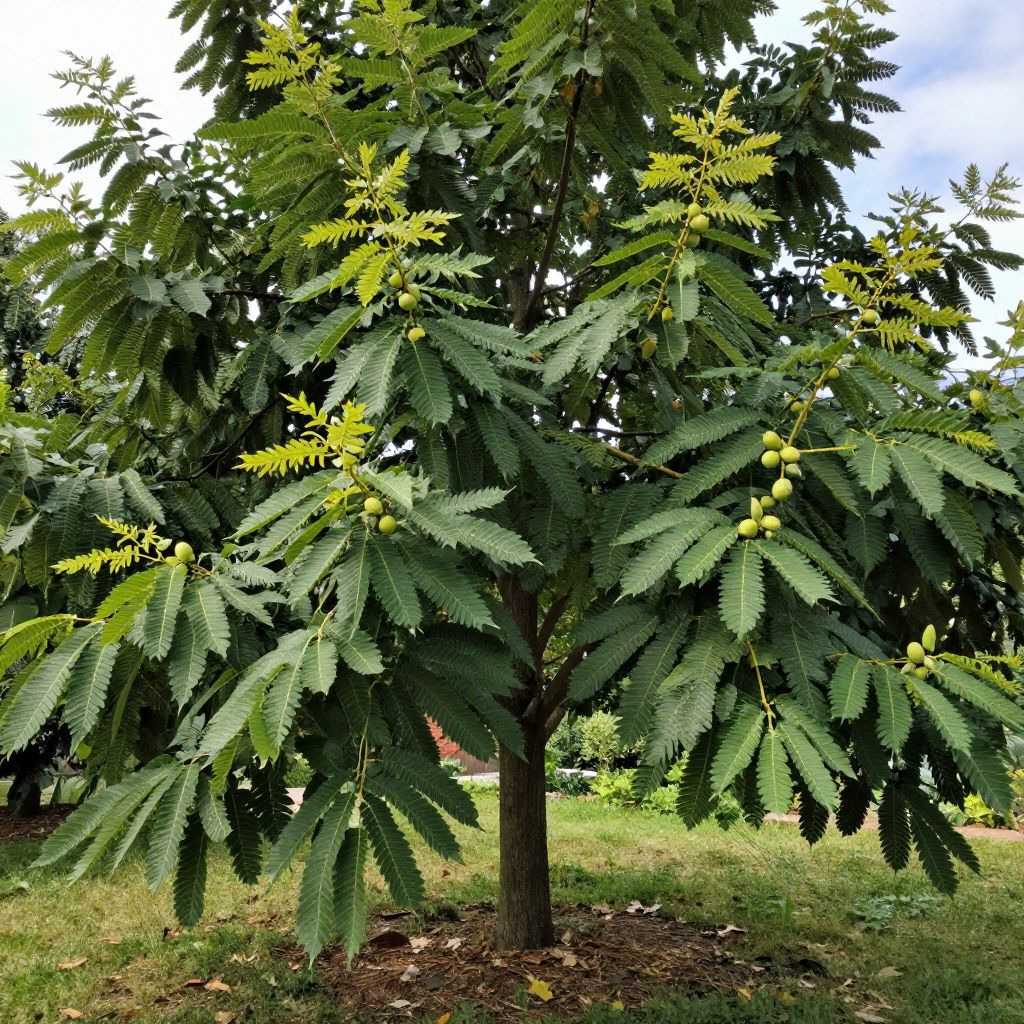
When you ask, “What does a pecan tree look like?” you’re usually trying to tell it apart from other nut trees or figure out whether a young sapling is really a pecan. The answer depends a little on age, but pecan trees have a few reliable traits you can learn quickly.
In the landscape, Carya illinoinensis is a large, graceful deciduous tree with long compound leaves, a straight trunk, and a broad canopy. Once you know the bark, leaf shape, and nut husks, identification becomes much easier.
What does a pecan tree look like?
A pecan tree is a tall, deciduous nut tree with pinnate compound leaves, gray-brown bark, and a spreading oval to rounded crown. Mature trees can become very large, often with a strong central trunk and long limbs. In season, they produce green husks that split open to reveal elongated pecans.
Key features to identify a pecan tree
Leaves: long, feather-like, and divided
Pecan leaves are one of the easiest clues. Each leaf is compound, meaning it is made up of several leaflets arranged along one stem.
- Usually 9 to 17 leaflets per leaf
- Leaflets are narrow, pointed, and slightly curved
- The overall leaf can be 12 to 20 inches long or more
- Leaflets have fine serrations along the edges
From a distance, the foliage looks airy and feathery rather than dense and broad like maple or oak leaves. In spring and summer, the leaves are medium to dark green; in autumn they turn yellow before dropping.
Bark: gray-brown and furrowed with age
Young pecan trees often have smoother bark, but mature trees develop a rough, ridged surface. The bark is typically gray to gray-brown and becomes deeply furrowed as the tree ages.
If you are trying to identify a young tree, bark alone may not be enough. Look for the leaf arrangement and overall growth habit too.
Shape and size: a big shade tree
Pecan trees are not small ornamental trees. They are large landscape trees that need room to spread both above and below ground. Mature trees often develop a tall trunk and a wide canopy that casts substantial shade.
In open space, the crown may look broad and somewhat rounded. In crowded settings, the tree may grow taller and narrower as it reaches for light.
Flowers and nuts: easy to spot in the right season
Pecan trees produce separate male and female flowers on the same tree. The flowers are not showy, so most gardeners notice the tree because of the nuts.
- Male flowers appear as long, hanging catkins
- Female flowers are smaller and less obvious
- Nuts form inside green husks that split open when mature
- The mature nut is elongated with a thin shell and edible kernel
When the husks split, the nut shape becomes a strong identification clue. Pecans are longer and more pointed than many other common tree nuts.
How to tell pecan trees apart from similar trees
Pecan vs. hickory
Pecan trees belong to the hickory family, so they can look similar. The main difference is usually the nut and leaflet shape. Pecan leaflets are often narrower and more numerous, and pecan nuts are more elongated and thinner-shelled than many hickory nuts.
Some hickories also have shaggy bark, while pecans usually show deeper furrows rather than long peeling strips.
Pecan vs. walnut
Walnut trees also have compound leaves, but their leaflets are usually broader and fewer. Walnut bark and fruit are different too. Walnuts have rounder fruits with thick green husks, while pecans produce more slender nuts in thinner husks.
Pecan vs. ash
Ash trees can have compound leaves, which sometimes causes confusion. However, ash leaflets are usually opposite each other on the stem, while pecan leaflets are arranged along the leaf stem in a more alternating pattern.
Also, ash does not produce pecan-like husked nuts.
Best growing conditions for pecan trees
If you are planting a pecan tree, identification is only the first step. These trees do best in full sun, deep soil, and a long warm season. They are large, long-lived trees, so site selection matters from the start.
- Sun: Full sun is best for healthy growth and nut production
- Soil: Deep, fertile, well-drained soil is ideal
- Drainage: Avoid waterlogged sites
- Space: Allow room for a large canopy and extensive roots
Pecans dislike compacted or shallow soil. If your yard has heavy clay, poor drainage, or a high water table, the tree may struggle even if it survives.
Soil preparation
Before planting, loosen the soil in a wide area rather than just digging a narrow hole. If your soil is poor, incorporate compost into the backfill only if needed and only lightly. The goal is to improve structure, not create a potting-hole effect that traps roots.
Avoid over-amending the planting hole. A tree planted in a pocket of rich, loose soil can send roots in circles instead of outward into the native soil.
How to plant a pecan tree
Planting a pecan tree correctly helps it establish faster and reduces stress in the first few years. Choose a young tree with a straight trunk and healthy roots, and plant it where it can remain for decades.
- Pick a site with full sun and ample space.
- Dig a hole as deep as the root ball and wider than the root spread.
- Set the tree so the root flare sits at or slightly above soil level.
- Backfill with native soil, firming gently to remove air pockets.
- Water thoroughly after planting.
- Mulch in a wide ring, keeping mulch a few inches away from the trunk.
Do not bury the trunk flare. Planting too deep is a common mistake that can weaken the tree over time.
Watering and care for young pecan trees
Newly planted pecan trees need consistent moisture while roots establish, but they should not sit in soggy soil. The right amount of water depends on rainfall, soil type, and temperature.
As a general rule, check the soil a few inches down. If it feels dry and crumbly, water deeply. If it still feels moist, wait.
Mulching
Mulch helps conserve moisture and reduce weeds. Use a 2- to 4-inch layer of wood chips or shredded bark, spread in a wide circle under the canopy area as the tree grows.
Keep mulch away from the trunk to prevent rot and pest hiding places.
Fertilizing
Young trees may benefit from a soil test before fertilizer is added. Pecans can be sensitive to poor nutrition, but overfertilizing can also cause weak growth. A soil test is the safest way to know whether your tree truly needs feeding.
Pruning pecan trees
Pruning helps develop a strong structure, especially when the tree is young. The goal is to create a sturdy central leader and well-spaced branches that can support future nut crops.
- Remove dead, damaged, or crossing branches
- Train a strong central trunk when the tree is young
- Keep scaffold branches spaced apart vertically
- Prune lightly rather than removing too much at once
For larger trees, major pruning is best left to a qualified arborist. Large cuts can stress the tree and may create entry points for disease.
Common pests and diseases
Pecan trees can face several pest and disease issues, especially in warm, humid regions. Early detection makes management much easier.
Common pests
- Leaf-feeding caterpillars
- Aphids or other sap-feeding insects
- Pecan weevils in nut-producing trees
- Scale insects on stressed trees
Common diseases
- Scab, especially in humid climates
- Powdery mildew in some conditions
- Root problems in poorly drained soil
Good airflow, proper spacing, and cleanup of fallen debris can reduce disease pressure. If you notice repeated leaf spotting, nut drop, or dieback, local extension guidance is often the best next step.
Harvesting pecans
If your tree is mature enough to produce nuts, harvest begins when the husks split and nuts start dropping. Some nuts may fall naturally, while others may need to be shaken loose gently.
Collect nuts promptly after they fall to reduce losses from insects, birds, and moisture. Dry them in a cool, airy place before storage.
Do not store damp pecans in a sealed container. Moisture can lead to mold and spoilage.
Propagation and starting new trees
Pecans are usually propagated by grafting named varieties rather than from seed. Seed-grown trees can be unpredictable in nut quality and may take many years to produce.
If you want reliable nuts, buy a grafted tree from a reputable nursery and choose a variety suited to your climate. If you are only identifying a tree, remember that wild seedlings may look like pecans but not produce the same quality crop.
Common mistakes to avoid
- Planting in shallow or poorly drained soil
- Giving the tree too little space
- Mulching against the trunk
- Overpruning young trees
- Assuming all compound-leaved trees are pecans
- Ignoring soil test results before fertilizing
Quick identification checklist
If you are standing in front of a tree and wondering whether it is a pecan, check these features in order:
- Are the leaves long and compound with many narrow leaflets?
- Is the tree large, upright, and broadly spreading?
- Is the bark gray-brown and furrowed?
- Are there elongated nuts in splitting green husks?
- Does the tree grow in full sun with plenty of room?
If most of these match, there is a good chance you are looking at a pecan tree.
Conclusion
Once you know what to look for, pecan trees are fairly easy to identify: long compound leaves, gray-brown furrowed bark, a large spreading form, and elongated nuts in splitting husks. If you are planting one, give it full sun, deep well-drained soil, and plenty of space to mature. For more tree care guidance, you may also find how to prune young trees and choosing the right mulch for trees helpful as you plan your landscape.