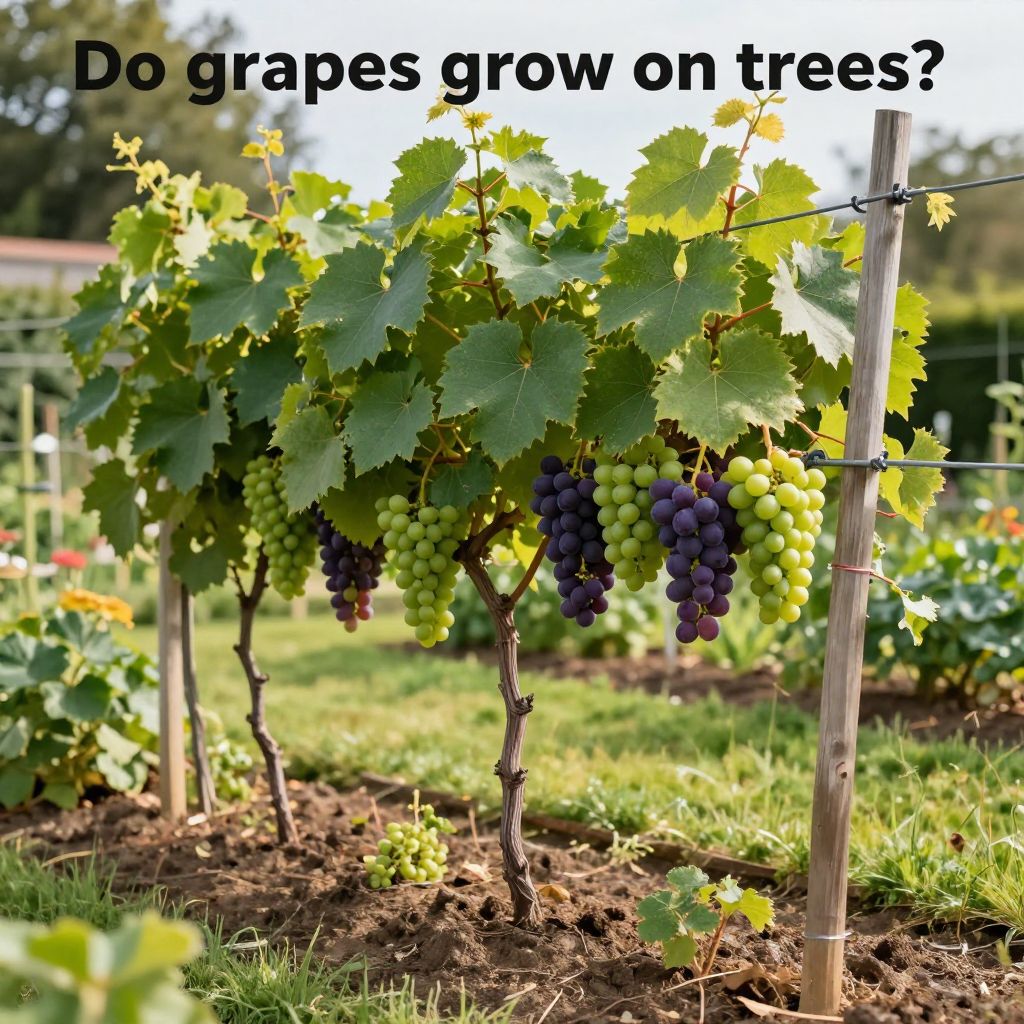
Do grapes grow on trees? No—grapes grow on woody vines, not trees. The plant is a climbing grapevine that uses support to lift its canes toward sunlight, and it can live for many years with the right pruning, training, and care.
If you want healthy fruit, think of grapes as a space-saving fruit crop that needs structure, airflow, and regular maintenance. Once you understand how the vine grows, it becomes much easier to plant, train, and harvest it successfully in a home garden.
Do grapes grow on trees?
No. Grapes grow on vines from the genus Vitis, not on trees. A grapevine is a woody climbing plant that needs a trellis, arbor, fence, or pergola for support. The fruit forms on new growth that develops from older wood, which is why pruning is such an important part of grape care.
What a grapevine needs to grow well
Grapes are not difficult once they are established, but they do best in a site that matches their growth habits. The main goals are full sun, good drainage, and enough room for the vine to spread without becoming tangled.
Sunlight and warmth
Choose the sunniest spot you have. Grapes generally need at least 6 to 8 hours of direct sun daily for good fruiting and ripening.
More sun usually means better flavor, drier foliage after rain, and fewer disease problems. In cooler climates, a warm south- or west-facing location often helps fruit ripen more reliably.
Soil and drainage
Grapevines prefer soil that drains well. Heavy, waterlogged soil can weaken roots and increase disease pressure.
- Loosen compacted soil before planting.
- Mix in compost to improve soil structure.
- Avoid low spots where water collects after rain.
- If your soil stays wet, consider planting on a raised bed or mound.
A slightly sandy or loamy soil is usually ideal, but grapes can adapt to many garden soils if drainage is decent.
Support structure
Because grapes are vines, they need a strong support system. A grapevine can become heavy once mature, especially when loaded with fruit.
- Trellis: Best for orderly rows and easy pruning.
- Fence: Good for training a vine along a boundary.
- Arbor or pergola: Attractive for shade, but harder to prune and harvest.
Make sure the support is sturdy enough to handle years of growth, wind, and the weight of mature canes.
How to plant grapevines
Planting correctly gives the vine a strong start. Bare-root vines are common in home gardens, but container-grown plants can also do well when planted at the right time for your climate.
- Pick a sunny, well-drained site with a permanent support structure in place.
- Dig a hole wide enough to spread the roots comfortably.
- Set the vine at the same depth it grew in the nursery, or just slightly deeper if needed for stability.
- Backfill with native soil, firm gently, and water thoroughly.
- Mulch lightly, keeping mulch a few inches away from the trunk.
Do not overdo compost or fertilizer in the planting hole. Too much rich material can encourage weak, overly lush growth at the expense of root establishment.
Spacing and training
Give each vine enough room to spread. The exact spacing depends on the variety, rootstock, and training system, but crowding usually leads to poor airflow and more disease.
Train the strongest shoot to the support during the first season. Early training helps build a framework that will be easier to prune later.
Watering and feeding grapes
Young grapevines need regular watering while they establish roots. Mature vines are more drought-tolerant, but they still perform best with consistent moisture during active growth and fruit development.
Watering tips
- Water deeply rather than giving shallow, frequent sprinkles.
- Let the top layer of soil dry slightly between waterings.
- Reduce watering if the soil stays damp for days after rain.
- Use mulch to help conserve moisture and suppress weeds.
In hot, dry weather, young vines may need more frequent attention. In humid or rainy climates, the bigger risk is often excess moisture and poor airflow rather than drought.
Fertilizer and compost
Grapes usually do not need heavy feeding. In many gardens, a modest application of compost in spring is enough to support healthy growth.
If the vine is growing too much leafy growth and producing little fruit, too much nitrogen may be part of the problem. Use fertilizer only if a soil test or clear deficiency symptoms suggest it is needed.
Pruning: the key to good grapes
Pruning is one of the most important parts of grape care. Grapes fruit on new shoots that grow from one-year-old wood, so if you skip pruning, the vine often becomes a tangled mass with fewer usable clusters.
Why pruning matters
- Improves sunlight exposure
- Increases airflow through the vine
- Helps control size and shape
- Supports better fruit quality
- Makes harvesting easier
Prune during the dormant season in your area, before strong spring growth begins. Exact timing depends on climate, so avoid pruning too early in very cold regions or too late once buds are swelling.
Basic pruning approach
For home gardeners, the exact system can vary, but the goal is always the same: keep a manageable framework and remove excess old growth. If you are new to grapes, start with a simple training method and follow it consistently year to year.
- Remove dead, damaged, or weak wood first.
- Keep the strongest permanent trunk and main arms.
- Cut back crowded side growth to maintain an open structure.
- Leave enough healthy one-year-old wood for fruiting.
Common mistake: leaving too much vine because it feels safer. Overgrown vines usually produce more leaves, not better fruit.
Common pests and diseases
Grapes can face several pests and diseases, especially in warm, humid, or crowded plantings. Good spacing, pruning, and sanitation prevent many problems before they start.
Pests to watch for
- Birds: often feed on ripening clusters; netting may be needed.
- Japanese beetles and other chewing insects: can damage leaves and fruit.
- Grape berry moth or similar fruit pests: may affect clusters in some regions.
- Spider mites: more common in hot, dry conditions.
Diseases to watch for
- Powdery mildew: white, dusty growth on leaves and fruit.
- Downy mildew: patchy leaf spotting and decline in wet conditions.
- Black rot: fruit and leaf lesions that can ruin clusters.
- Botrytis bunch rot: more likely when clusters stay damp and crowded.
To reduce disease pressure, keep the canopy open, remove fallen fruit and leaves, and water at the base rather than overhead when possible. If a problem becomes severe, choose a control method that is labeled for grapes and appropriate for your region.
How to propagate grapes
Grapes are commonly propagated from cuttings, which is one reason they are a popular home fruit crop. If you already have a healthy vine and want more plants, cuttings are often the simplest method.
Simple cutting basics
- Take dormant hardwood cuttings from healthy canes.
- Use clean, sharp pruners.
- Keep each cutting oriented correctly, with buds facing up.
- Place cuttings in a suitable rooting medium or follow a reliable local propagation method.
Not every cutting will root, so take several. If you are new to propagation, start with one or two plants and learn from the results before expanding.
Harvesting grapes at the right time
Grapes do not continue to ripen much after harvest, so timing matters. Harvest when the fruit has developed full color, good flavor, and the seeds are mature, depending on the variety.
Signs grapes are ready
- Clusters look fully colored for the variety
- Berries taste sweet, not sharp or grassy
- The fruit has a slight softness but is still firm enough to handle
- Stems begin to brown slightly as the cluster matures
Use clean snips or scissors to cut clusters rather than pulling them off. Handle ripe fruit gently, since bruising shortens storage life.
Growing grapes in small spaces
You do not need a large orchard to grow grapes. A single vine can be trained along a fence, over a pergola, or on a compact trellis if you prune it regularly.
For small gardens, the biggest challenge is often not space but maintenance. A neglected grapevine quickly becomes too dense, so choose a training system you can keep up with each season.
Best small-space habits
- Pick one main support and keep the vine tied neatly to it.
- Prune every dormant season.
- Remove weak or tangled shoots during the growing season.
- Keep the area under the vine weed-free.
Troubleshooting common grape problems
If your vine looks healthy but does not fruit well, the issue is often cultural rather than genetic. Sun, pruning, and vigor are usually the first things to check.
Too many leaves, few grapes
This often means the vine is getting too much nitrogen, too much shade, or too little pruning. Reduce excess feeding, improve light, and prune more consistently.
Fruit split or rots before harvest
Splitting can happen after irregular watering or heavy rain near ripening. Rot is more likely when clusters are crowded and damp. Improve airflow and keep watering steady when possible.
Leaves look spotted or dusty
That may point to mildew or another fungal disease. Remove badly affected growth, improve air circulation, and avoid wetting the foliage late in the day.
Vine grows weakly
Check for poor drainage, root damage, compacted soil, or too much competition from weeds and nearby plants. A stressed vine often needs better site conditions more than more fertilizer.
Conclusion: grow grapes as vines, not trees
So, do grapes grow on trees? No—they grow on trained vines that need sun, support, pruning, and decent drainage. If you give your vine a strong trellis, keep it open and airy, and prune it each dormant season, you will set yourself up for healthier growth and better fruit.
If you want to keep learning, you may also find when to prune grape vines helpful for timing your yearly maintenance.