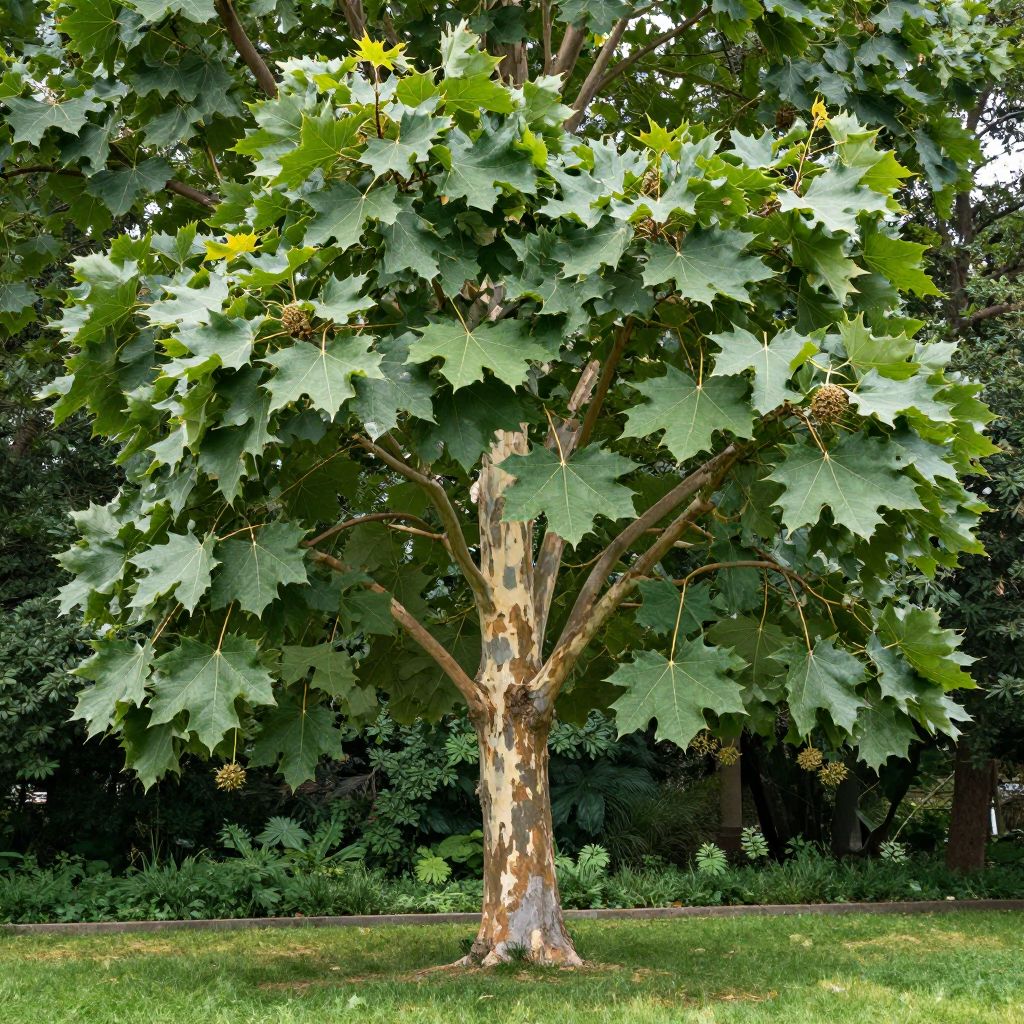
What does a sycamore tree look like? If you’re trying to identify one in a yard, park, or along a stream, the answer is usually in the bark, leaves, and overall size. Sycamores are large, fast-growing shade trees with broad canopies and distinctive mottled bark that peels in patches.
They’re easy to confuse with other plane trees, maples, or even some poplars at a glance. Below, you’ll learn the key identification features, where sycamores grow best, and how to care for one if you’re planting or maintaining it in your landscape.
What does a sycamore tree look like?
A sycamore tree is a large deciduous tree with a broad, rounded crown, huge maple-like leaves, and distinctive bark that flakes away to reveal creamy, tan, and gray patches. In many landscapes, the most recognizable clue is the trunk: it often looks camouflage-patterned and becomes very large with age.
Key features for identifying a sycamore tree
1. The bark is the biggest giveaway
Sycamore bark is usually the easiest feature to spot. Mature trunks and larger limbs often show a patchwork of white, gray, olive, and tan because the outer bark naturally peels in irregular plates.
This peeling look is especially noticeable in winter when the tree is leafless. Young sycamores may have smoother bark at first, so bark alone is most useful on older trees.
2. Leaves are large and maple-like
Sycamore leaves are broad, alternate, and generally shaped like a maple leaf, with 3 to 5 lobes and coarse teeth along the edges. They can be quite large, often several inches across, and the veins are prominent.
In fall, the leaves usually turn yellow-brown before dropping. If you’re comparing trees, remember that sycamore leaves are broader and less sharply lobed than many true maples.
3. The seed balls hang in clusters
Sycamores produce round seed balls that hang on long stalks, often one to several together. These seed heads persist into winter and can help confirm identification when leaves are gone.
The balls break apart gradually and release seeds with fine hairs that help them disperse. If you see these dangling spheres under a large tree, sycamore is a strong possibility.
4. The tree is tall, spreading, and very shade-producing
Sycamores are big trees. They can grow into massive landscape specimens with wide canopies and thick trunks, making them excellent shade trees where there is enough room.
Because they get large, they’re best suited to parks, large yards, and naturalized areas rather than small foundation plantings or tight suburban spaces.
How to tell a sycamore from similar trees
Sycamore vs. maple
Both can have lobed leaves, but sycamore leaves are usually larger and more leathery-looking. The bark is also very different: maples do not typically have the same mottled, exfoliating trunk pattern.
Sycamore vs. London plane tree
London plane tree is closely related and often looks extremely similar. If you’re unsure, the bark and seed balls may still look nearly identical, so the distinction can be difficult without local context.
In many home landscapes, people use “sycamore” loosely for several plane-type trees. If the tree has mottled bark, large lobed leaves, and hanging seed balls, identification is usually close enough for gardening purposes.
Sycamore vs. poplar or cottonwood
Poplars and cottonwoods can also be large and fast-growing, but their leaves are usually more triangular or heart-shaped, not deeply lobed. Their bark is different too, lacking the patchy, camouflage effect of sycamore.
Where sycamores grow best in the landscape
Sycamores do best in full sun and in soil that stays evenly moist but still drains well. In nature, you’ll often find them near rivers, floodplains, and low-lying areas because they tolerate periodic wetness better than many trees.
For home gardens, give them plenty of space. Their roots, canopy, and eventual trunk size all need room, so avoid planting too close to patios, driveways, sewer lines, or buildings.
Soil and drainage
Sycamores adapt to many soil types, including clay and loam, but they perform best when the soil is deep and not compacted. Good drainage matters, especially for young trees establishing roots.
If your soil is heavy clay, improve the planting area with organic matter only if needed for structure, not as a substitute for drainage. Avoid creating a “bathtub” hole that holds water around the roots.
Sunlight needs
These trees are sun lovers. While a young sycamore may tolerate partial shade, full sun encourages stronger growth, a fuller crown, and better overall vigor.
Planting a sycamore tree
If you’re planting a sycamore, choose a site with enough overhead and lateral space for its mature size. This is not a tree to squeeze into a small bed and hope for the best.
- Dig a hole only as deep as the root ball and about 2 to 3 times as wide.
- Set the tree so the root flare is at or slightly above soil level.
- Backfill with the native soil you removed, breaking up clods as needed.
- Water thoroughly to settle the soil around the roots.
- Mulch with 2 to 4 inches of organic mulch, keeping it a few inches away from the trunk.
Avoid planting too deep. One of the most common tree-planting mistakes is burying the root flare, which can lead to stress and decline over time.
Watering and early care
Newly planted sycamores need consistent moisture while they establish, especially during warm or windy weather. The goal is deep, infrequent watering rather than light daily sprinkling.
Check the soil a few inches down. If it feels dry, water slowly so moisture reaches the root zone. If the soil stays soggy for long periods, reduce watering and check drainage.
Mulching tips
Mulch helps moderate soil temperature and conserve moisture, which is especially useful for young trees. Use wood chips, shredded bark, or leaf mulch in a wide ring under the canopy if possible.
Keep mulch from touching the trunk. A mulch volcano traps moisture against the bark and can invite decay and pests.
Pruning sycamore trees
Prune sycamores lightly and with purpose. They naturally form a broad canopy, and heavy pruning can weaken the tree or create poorly attached shoots.
Remove only dead, damaged, rubbing, or crossing branches when needed. For larger limbs, use clean cuts and avoid leaving stubs.
When to prune
For many home gardeners, late winter or very early spring is a practical time to inspect and prune while the tree is dormant. However, timing can vary by climate and the tree’s condition.
If the tree is large or limbs are near structures or power lines, hire a certified arborist. Sycamores can become massive, and improper pruning is risky.
Common pests and diseases
Sycamores are generally tough, but they can still face pest and disease problems, especially if stressed by drought, poor soil, or root damage.
Sycamore anthracnose
This fungal disease can cause leaf spotting, blight, and premature leaf drop, especially during cool, wet springs. It often looks worse on young leaves and new growth.
Healthy trees usually recover, but repeated severe infections can weaken them. Raking and removing fallen leaves can help reduce disease carryover, and improving airflow around the tree may also help.
Insects and other issues
Sycamores may also attract lace bugs, borers, and scale insects in some regions. Symptoms can include stippled leaves, thinning canopy, or branch dieback.
If you notice unusual decline, check for stress factors first: compacted soil, drought, root damage, or planting too deep. A stressed tree is more likely to suffer pest problems.
Propagation and replacement planting
Home gardeners usually don’t propagate sycamores from cuttings the way they might with shrubs. Seed propagation is possible, but for most landscapes, buying a healthy nursery-grown tree is the most practical option.
If you need to replace a sycamore, choose a site that matches the tree’s mature size and moisture needs. A young tree may look small now, but it will eventually need a lot of room.
What to watch for in each season
Spring
Look for fresh leaves, new shoots, and any signs of anthracnose or frost injury. Spring is also a good time to assess whether the tree is leafing out evenly.
Summer
Watch for drought stress, leaf scorch, and insect activity. Young trees may need supplemental watering during hot spells, especially in sandy or fast-draining soil.
Fall
Leaves usually turn yellow-brown before dropping. This is a good time to inspect the canopy structure and note any dead limbs that may need removal later.
Winter
The bark and seed balls are easiest to see in winter. This is often the best season for identification if the tree is bare.
Common mistakes when identifying or growing sycamores
- Confusing sycamore with any large maple because both have lobed leaves.
- Ignoring bark texture, which is often the most reliable clue.
- Planting too close to buildings, sidewalks, or utility lines.
- Overwatering young trees in poorly drained soil.
- Mulching against the trunk instead of around it.
- Overpruning a tree that naturally wants to grow large and broad.
Quick identification checklist
- Large deciduous tree with a spreading crown
- Mottled, peeling bark in white, gray, tan, and olive tones
- Broad, lobed leaves with coarse edges
- Round seed balls hanging on stalks
- Often found near moisture or in roomy landscape settings
Final thoughts
If you’re wondering what does a sycamore tree look like, start with the bark, then confirm with the leaves and seed balls. Once you know those features, sycamore becomes much easier to identify in any season.
If you’re planning to grow one, give it sun, space, and well-drained soil, then keep an eye on watering and early pruning. For more help identifying trees in your garden, you may also find what type of tree is this? useful.