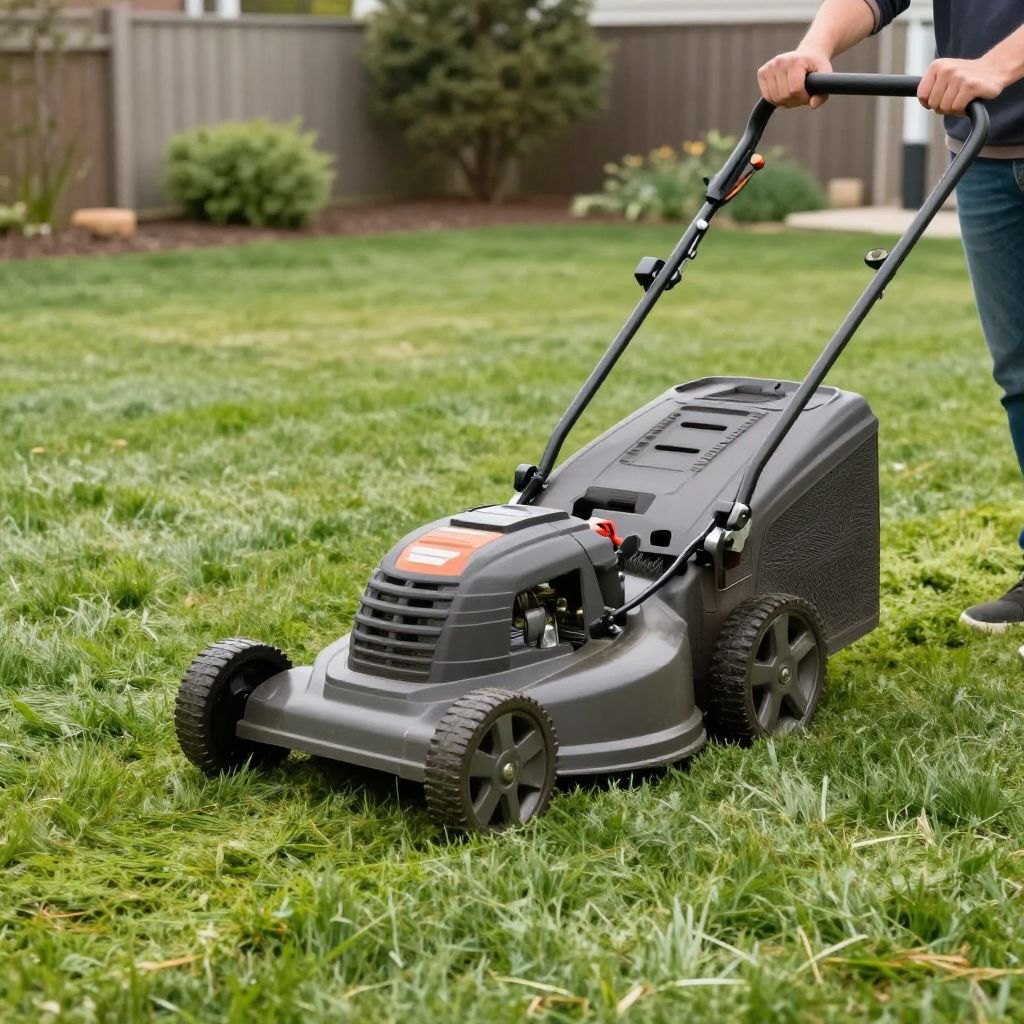
If you’re asking, “What is self propelled lawn mower?” you’re probably trying to understand whether this type of mower will make yard work easier. The short answer is that it’s a mower with a drive system that moves the wheels for you, so you guide it rather than push all of its weight yourself.
That makes it especially useful on larger lawns, uneven ground, or slopes where a standard push mower can feel tiring. Choosing the right mower still depends on your lawn size, terrain, and how much control you want while mowing.
What is self propelled lawn mower?
A self propelled lawn mower is a mower with a built-in drive system that powers the wheels while the blade still cuts the grass. You still steer and control the pace, but the mower does most of the forward work, which reduces strain and can improve mowing consistency on many lawns.
How to identify a self propelled lawn mower
If you are shopping in a store or looking at an existing mower, there are a few easy signs that tell you it is self propelled. The most obvious clue is a drive control on the handle, often a bar, lever, or bail you must hold to engage the wheels.
- Drive control on the handle: A separate lever or bar usually starts and stops wheel movement.
- Speed control: Many models let you adjust walking speed to match your pace.
- Rear or front wheel drive label: This tells you which wheels receive power.
- Heavier frame: Self propelled models often weigh more than basic push mowers.
- Transmission housing: You may notice extra mechanical parts near the wheels or under the deck.
Some mowers look similar at first glance, so check the owner’s manual or product label if you are unsure. If the mower only runs when you push it forward and has no wheel-drive control, it is likely a standard push mower.
How a self propelled mower works
The engine or battery powers both the cutting blade and the wheel drive system. Once engaged, the mower pulls itself forward while you guide direction, manage turns, and control whether to stop or continue.
Common drive types
- Front-wheel drive: Easier to maneuver and often helpful for flat lawns or yards with obstacles.
- Rear-wheel drive: Often better for hills and traction, especially on sloped ground.
- All-wheel drive: Provides extra grip in challenging conditions, though it is usually more expensive.
The best drive type depends on your terrain. For example, a hilly yard usually benefits from better traction, while a flatter lawn may be easier to handle with a lighter, more maneuverable model.
Is a self propelled mower right for your garden?
This mower is a practical choice if you mow regularly and want less physical effort. It can be especially helpful if your lawn is large, has slopes, or includes long mowing sessions that leave you tired.
Good fit for these situations
- Medium to large lawns
- Slopes or uneven ground
- Gardeners who want less pushing effort
- Lawns that need frequent mowing during active growing seasons
May not be necessary if
- Your lawn is very small and flat
- You prefer the lightest possible mower
- You only mow occasionally and do not mind manual pushing
Remember that self propelled does not mean effortless. You still need to steer, turn, and sometimes slow the mower on tight corners or thick grass.
How to use a self propelled lawn mower safely and effectively
Using this mower well is mostly about control, not speed. A steady walking pace usually gives the cleanest cut and helps the mower avoid bogging down in thick patches.
- Clear the lawn of sticks, stones, toys, and hoses before mowing.
- Check that the blade is sharp and the deck is free of packed grass.
- Set the cutting height for the season and grass type.
- Start the mower on level ground if possible.
- Engage the drive control and walk at a comfortable pace.
- Overlap each pass slightly to avoid missed strips.
- Slow down in thick grass and around turns.
Do not force the mower downhill faster than it wants to travel. Let the drive system work at a controlled pace, especially on slopes or when the grass is damp.
Best mowing practices for healthy grass
A self propelled mower can improve mowing comfort, but the health of your lawn still depends on good mowing habits. Cutting too short, mowing with a dull blade, or mowing when grass is wet can stress turf no matter what type of mower you use.
Helpful mowing habits
- Mow when the grass is dry enough to cut cleanly.
- Keep blades sharp for a cleaner cut and less tearing.
- Follow the one-third rule: avoid removing more than one-third of the grass blade at a time.
- Change mowing direction occasionally to reduce ruts and leaning grass.
- Adjust cutting height with the season and grass growth rate.
If your lawn is stressed by heat, drought, or shade, raise the cutting height a little. Taller grass often shades the soil, helps retain moisture, and supports stronger roots.
Common problems with self propelled mowers
Like any garden tool, these mowers need regular maintenance. When something feels off, the problem is often simple and fixable.
Mower moves too slowly or not at all
This can happen if the drive belt is worn, the cable is loose, or the drive system needs service. Check the manual first, since some models have simple adjustments for cable tension.
Wheels slip on slopes or wet grass
Traction problems are common on damp turf or steep ground. Try mowing when conditions are drier, and consider a rear-wheel-drive or all-wheel-drive model if your yard is consistently hilly.
Uneven cutting or missed strips
Often the issue is a dull blade, mowing too fast, or grass that is too tall for one pass. Make two passes at a higher setting if needed, rather than forcing one heavy cut.
Hard to turn at the end of a row
Some self propelled mowers feel heavy in tight spaces. Reduce speed before turning, and consider a front-wheel-drive model if your lawn has many beds, trees, or narrow paths.
Maintenance tips to keep it working well
Regular care keeps the mower reliable through the growing season and helps it cut more cleanly. Basic maintenance also reduces wear on the drive system and engine or battery components.
- Clean grass clippings from under the deck after mowing.
- Inspect wheels and drive components for debris buildup.
- Sharpen or replace the blade as needed.
- Check the air filter and spark plug on gas models according to the manual.
- Store the mower in a dry, sheltered place.
For gas models, fuel care matters too. Old fuel can cause starting issues, so follow the manufacturer’s storage guidance between seasons.
Self propelled vs push mower: what’s the difference?
The main difference is who provides the forward motion. A push mower relies entirely on your strength, while a self propelled mower uses a drive system to move itself.
- Push mower: Lighter, simpler, often less expensive, but more physical to use.
- Self propelled mower: Easier to handle on larger or sloped lawns, but usually heavier and more complex.
If your lawn is small and level, a push mower may be enough. If mowing feels tiring or your terrain is challenging, self propulsion can make routine lawn care much easier.
Buying tips for home gardeners
When comparing models, look beyond the “self propelled” label. The right mower should match your lawn size, storage space, and the kind of terrain you actually mow.
What to check before buying
- Drive type: front-wheel, rear-wheel, or all-wheel drive
- Weight and how easy it is to turn
- Cutting width for your lawn size
- Height adjustment range
- Bagging, mulching, or side-discharge options
- Whether you prefer gas or battery power
Try to handle the mower in person if possible. A model that seems ideal on paper may feel too heavy, awkward, or fast once you actually guide it around your garden beds and edges.
Conclusion
A self propelled lawn mower is a wheel-driven mower that reduces pushing effort while still letting you steer and control the cut. It is a smart choice for many home lawns, especially if you want easier mowing on slopes, larger spaces, or rougher ground.
If you are comparing mower types, you may also want to read about what kind of oil a lawn mower takes so you can keep a gas model running smoothly.