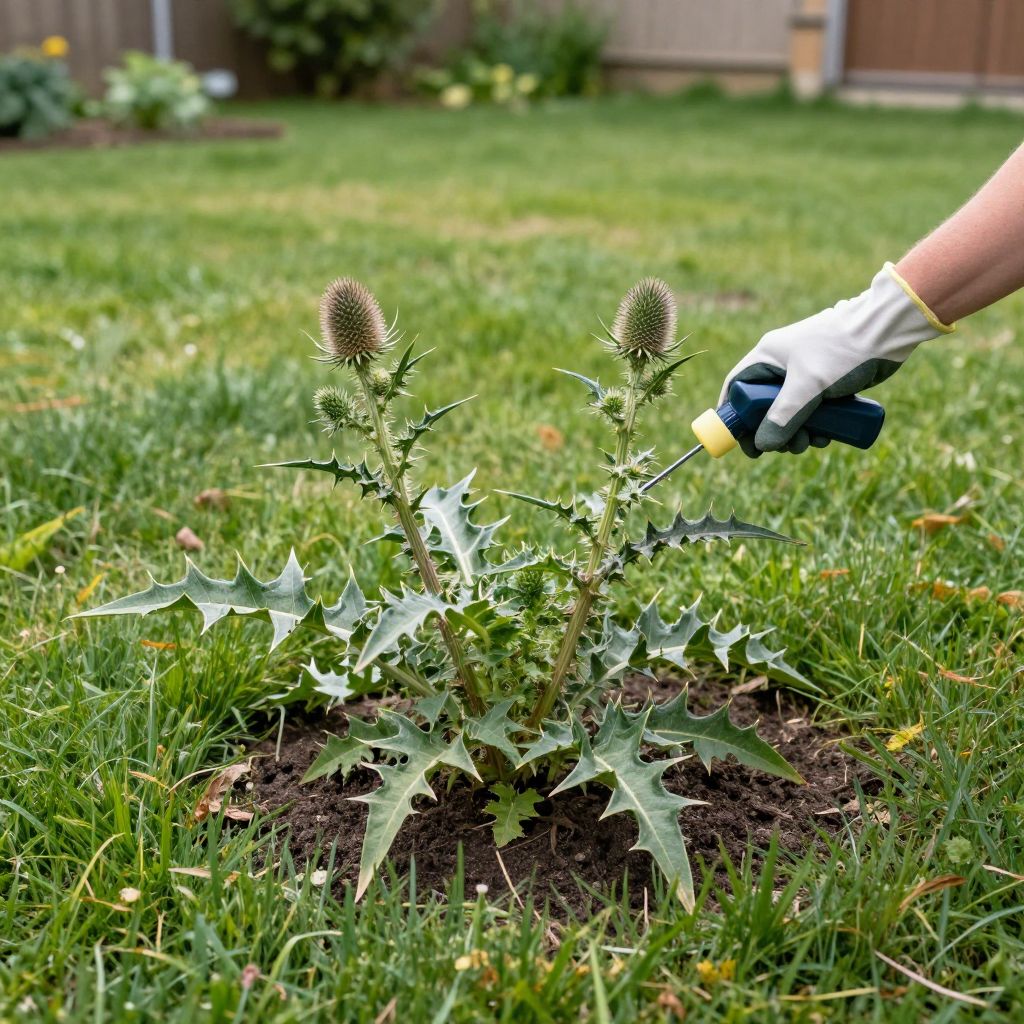
If you’re asking what kills thistles but not grass, the best answer is a selective broadleaf herbicide used at the right time, plus good lawn care to prevent thistles from returning. Thistles are broadleaf weeds, so products labeled for lawn use can target them without harming most turf grasses when applied correctly.
For small patches, repeated digging, cutting, and improving lawn density can work well too. The key is to attack thistles before they flower and set seed, then follow up so new seedlings do not take over bare spots.
What kills thistles but not grass?
Selective broadleaf herbicides are the most reliable option for killing thistles without damaging grass. Look for lawn-safe products labeled for thistle control and follow the label exactly. For best results, spray young, actively growing thistles in mild weather and avoid mowing right before or after treatment.
Why thistles are so hard to control
Thistles are tough because many types have deep taproots, prickly leaves, and a strong ability to regrow from the root if you only cut the top off. Some also spread by seed, so one neglected plant can become many.
In lawns, thistles usually show up where grass is thin, compacted, or struggling. Bare soil, poor drainage, low fertility, and heavy foot traffic all give them an opening.
Common lawn thistles
- Canada thistle (Cirsium arvense) — spreads aggressively and can return from root pieces.
- Bull thistle (Cirsium vulgare) — often grows as a spiny rosette before sending up a tall flowering stalk.
- Milk thistle (Silybum marianum) — a coarse annual or biennial with white-marbled leaves.
Best ways to kill thistles without harming grass
1. Use a selective broadleaf herbicide
This is the most common answer for established thistles in turf. Products containing ingredients such as 2,4-D, dicamba, MCPP, triclopyr, or combinations of these are often used on lawns because they target broadleaf weeds while leaving most grasses unharmed.
Important: not every lawn product is safe for every grass type. Always check the label for your specific turf, especially if you have St. Augustinegrass, bentgrass, buffalo grass, zoysia, centipedegrass, or newly seeded lawns.
For best control:
- Apply when thistles are actively growing, not drought-stressed.
- Target rosette-stage plants before flowering if possible.
- Spray on a calm day to reduce drift onto ornamentals and vegetables.
- Do not mow for a day or two before and after, if the label recommends it.
2. Spot-treat instead of spraying the whole lawn
Thistles often grow in scattered clumps. Spot treatment saves product, reduces risk to desirable plants, and is usually easier to manage in home lawns.
Use a handheld sprayer or ready-to-use applicator and wet the leaves evenly without soaking the soil. If the thistle patch is large, treat only the affected area and monitor the rest of the lawn for new seedlings.
3. Dig out young plants and roots
For small infestations, hand digging can be effective, especially after rain or watering when the soil is softer. Use a dandelion digger, hori-hori, or sturdy trowel to lift as much of the taproot as possible.
With perennial types like Canada thistle, even a small root fragment can resprout. If you dig, check the area every couple of weeks and remove new shoots promptly.
4. Mow before seed heads form
Mowing alone usually will not kill thistles, but it can stop flowering stalks from setting seed. This is helpful if you cannot treat immediately.
Bag or remove any seed heads you cut if they are already formed. Do not compost mature thistle seed heads unless your compost system gets hot enough to destroy seeds reliably.
How to treat thistles safely in a lawn
- Identify the thistle and check whether it is in a lawn, garden bed, or wild area.
- Read the herbicide label to confirm it is safe for your grass species.
- Choose a mild day with little wind and no rain expected for the label’s rainfast period.
- Apply to actively growing foliage, preferably when the plant is young and not drought-stressed.
- Wait and watch. Many thistles need more than one treatment.
- Recheck in 2 to 4 weeks and retreat only as the label allows.
Do not guess at rates or mix products unless the label specifically allows it. More herbicide does not mean better control, and it can damage grass or nearby plants.
What not to do when killing thistles
- Do not pull mature thistles by hand without getting the root. They often regrow.
- Do not mow repeatedly and assume the problem is solved. Many thistles recover from the crown or roots.
- Do not spray on windy days, because drift can injure flowers, shrubs, and vegetables.
- Do not apply herbicide to heat-stressed or drought-stressed grass unless the label says it is safe.
- Do not let thistles flower if you can help it. Seed spread is one of the fastest ways infestations expand.
Natural and non-chemical control options
If you prefer to avoid herbicides, you can still reduce thistles, but it usually takes more persistence. The goal is to weaken the plant’s root reserves and prevent seeding.
Smothering and repeated cutting
In beds or neglected areas, cover the patch with cardboard and mulch, or use a tarp to block light. This works best on small patches and may take a full season or longer.
Repeatedly cutting thistles at the base can also help, especially if you do it as soon as regrowth appears. The plant uses stored energy to resprout, and repeated removal gradually exhausts it.
Improve the lawn so thistles have less room
A thick, healthy lawn is one of the best long-term defenses. Thistles thrive where grass is thin, so improving turf density makes future infestations less likely.
- Raise mowing height to suit your grass type.
- Repair bare patches with seed or sod appropriate for your region.
- Aerate compacted soil if needed.
- Topdress lightly with compost where the soil is poor.
- Water deeply but not constantly, so grass roots grow deeper.
When thistles keep coming back
If the same patch returns after treatment, you may be dealing with a perennial thistle with spreading roots, or the area may be producing new seedlings from nearby seed sources. In that case, one pass is rarely enough.
Check the surrounding area for flowering weeds, fence lines, ditch banks, and neglected borders. Thistle seed can blow or move in on clothing, pets, equipment, and mowers.
Troubleshooting stubborn infestations
- Plants look wilted but recover: the spray may have missed enough leaf area, or the plant was too mature.
- New thistles appear after mowing: seeds were already present in the soil or drifting in from nearby areas.
- Grass shows damage too: the product may not be safe for your turf type, or it was applied too heavily.
- Thistles in flower beds: use careful hand removal or shielded spot treatment, not broad lawn spraying.
Seasonal timing matters
Thistles are easiest to control when they are young and actively growing. In many climates, that means spring and early fall are the most effective treatment windows, but local weather matters more than the calendar.
Avoid treating during extreme heat, drought, or when the plant is stressed. A stressed weed may not absorb herbicide well, and a stressed lawn is more likely to be injured too.
Preventing thistles from returning
Once you’ve knocked back the current plants, prevention is the real win. The best prevention is a dense lawn, regular inspection, and fast removal of any new rosettes before they mature.
- Walk the lawn every couple of weeks during the growing season.
- Pull or spot-treat tiny seedlings early.
- Fill bare spots quickly so weeds do not colonize them.
- Clean mower decks and tools if you suspect seed spread.
- Keep edges, fence lines, and neglected corners under control.
Bottom line
If you want to know what kills thistles but not grass, start with a selective broadleaf herbicide labeled for your turf, or dig and remove young plants before they seed. Then strengthen the lawn so thistles have fewer openings to return.
For more lawn-weed help, you may also find these guides useful: what kills dandelions but not grass and what kills creeping charlie but not grass.