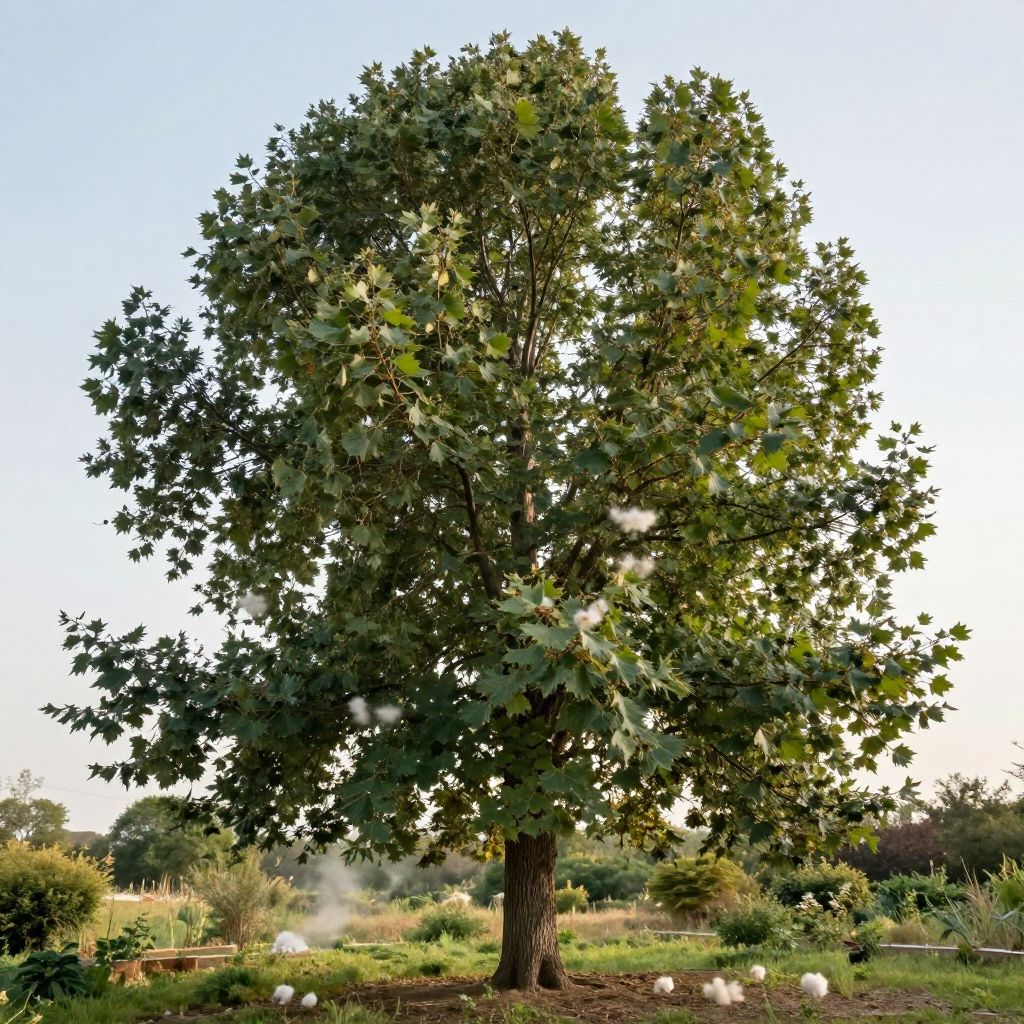
If you’re trying to figure out what does a cottonwood tree look like, the answer is usually “a tall, fast-growing poplar with broad, triangular leaves and a loose, open crown.” Cottonwoods are easy to spot near water, where they can reach impressive size and spread quickly.
They are useful shade trees in the right place, but they can also be messy and aggressive growers. Knowing how to identify cottonwood correctly helps you decide whether to leave one alone, prune it carefully, or avoid planting one too close to structures.
What does a cottonwood tree look like?
Cottonwood trees are large deciduous trees in the Populus genus, usually with a straight trunk, rough gray bark, and broad leaves that flutter in the wind. The leaves are often triangular or heart-shaped with long flattened stems, and mature trees produce fluffy cotton-like seed fluff in spring or early summer.
Key cottonwood identification features
Leaves
Cottonwood leaves are one of the easiest clues. They are typically broad, triangular to diamond-shaped, with a pointed tip and finely toothed edges.
- Shape: triangular, deltoid, or heart-shaped depending on the species
- Size: often 2 to 5 inches long, sometimes larger on vigorous shoots
- Petiole: long and flattened, which makes the leaves tremble in the wind
- Color: shiny green above, paler underneath
That fluttering leaf movement is a classic poplar trait and helps distinguish cottonwood from many other broadleaf trees.
Bark
Young cottonwoods often have smoother, lighter bark, while older trees develop thick, deeply furrowed bark that turns gray to dark gray. The bark can look rough and blocky as the tree matures.
If you see a very large tree with a straight trunk and rugged bark near a stream, ditch, or low-lying area, cottonwood is a strong possibility.
Overall shape and size
Cottonwoods are known for fast growth and substantial height. They often develop a tall, upright trunk with a broad, somewhat open canopy rather than a dense, rounded crown.
- Growth habit: upright and fast-growing
- Canopy: open, irregular, and spreading with age
- Roots: extensive and moisture-seeking
Because of their size, cottonwoods are not small-yard trees. They need room above and below ground to grow safely.
Catkins and cottony seed fluff
In spring, cottonwoods produce long catkins before or as leaves emerge. Female trees later release fluffy seeds that look like cotton drifting through the air, which is where the tree gets its common name.
Important: not every fluffy white seed mass in a landscape comes from a cottonwood, but cottonwood fluff is a strong identification clue when it appears in large drifts.
Where cottonwoods grow best
Cottonwoods naturally grow in moist soils and are commonly found along rivers, floodplains, creek banks, and low areas where groundwater is accessible. They tolerate wet soil better than many landscape trees.
They can survive in a range of conditions, but they usually perform best where roots can reach consistent moisture. Dry, compacted sites often stress them and can shorten their lifespan.
Ideal growing conditions
- Sunlight: full sun is best
- Soil: moist, deep, and reasonably fertile
- Drainage: good drainage is helpful, but they handle wetter soils than many trees
- Space: plenty of room for roots and canopy spread
If you are planting in a home landscape, think carefully before choosing cottonwood. Its roots can seek out irrigation lines, septic areas, and drainage systems.
How to tell cottonwood apart from similar trees
Cottonwood is often confused with other poplars, aspens, and some willows. A few details can help you narrow it down.
Cottonwood vs. aspen
Aspens are usually smaller and more slender, with smoother bark and rounder leaves. Cottonwoods tend to be larger, rougher-barked, and more strongly associated with wet ground.
Cottonwood vs. willow
Willows have long, narrow leaves, while cottonwoods usually have broader, triangular leaves. If the tree has narrow, drooping foliage, it is more likely a willow than a cottonwood.
Cottonwood vs. sycamore
Sycamores have mottled, exfoliating bark and large palmate leaves, which look very different from cottonwood’s triangular leaves and rough gray bark. If you want a comparison, see what a sycamore tree looks like.
Should you plant a cottonwood tree?
In many home gardens, the answer is no unless you have a very large property and a suitable site. Cottonwoods grow quickly, but that speed comes with tradeoffs: large roots, leaf litter, seed fluff, and potential structural issues as the tree ages.
They can be valuable in restoration plantings, windbreaks, or naturalized areas where space and moisture are available. In a small suburban yard, they are often too large and too vigorous.
Good places for cottonwood
- Large rural properties
- Riparian or restoration areas
- Windbreaks far from buildings
- Sites with naturally moist soil
Places to avoid
- Near foundations or patios
- Close to sewer, septic, or water lines
- Small lawns with limited canopy space
- Areas where litter and fluff will be a nuisance
Planting and early care
If you do plant a cottonwood, give it the right start. The most important thing is location, because a cottonwood that is planted too close to structures can become a long-term problem.
- Choose a site with full sun and plenty of open space.
- Dig a hole as deep as the root ball and two to three times as wide.
- Set the tree so the root flare is at or slightly above soil level.
- Backfill with native soil unless your soil is extremely poor.
- Water deeply after planting and keep the root zone evenly moist while the tree establishes.
- Mulch with 2 to 4 inches of organic mulch, keeping it a few inches away from the trunk.
Do not bury the trunk flare or pile mulch against the bark. That can lead to rot and pest problems.
Pruning cottonwood trees
Cottonwoods often need pruning less for shape and more for safety. Because they grow fast, they can develop weak branch unions, broken limbs, or crowded upper growth.
When to prune
Light pruning is usually best during the dormant season or when the tree is not actively stressed by heat or drought. Avoid heavy pruning in the middle of summer unless you are removing damaged or hazardous limbs.
What to remove
- Dead, broken, or diseased branches
- Crossing limbs that rub together
- Weakly attached branches with narrow crotch angles
- Low limbs that interfere with traffic or mowing
Use clean, sharp tools and make cuts just outside the branch collar. If the tree is large, hire an arborist rather than trying to climb or overreach.
Common pests and diseases
Cottonwoods can be prone to several pests and diseases, especially when stressed by drought, poor site conditions, or injury.
Common issues
- Aphids: may cause sticky honeydew and leaf curling
- Leaf beetles or caterpillars: can chew foliage
- Cankers: sunken or dead areas on branches and trunk
- Leaf spot: dark or discolored patches on leaves
- Root stress: often linked to compacted soil or poor drainage in the wrong way
Most healthy trees can tolerate some pest pressure. The best prevention is proper siting, deep watering during dry spells, and avoiding trunk wounds.
Propagation and volunteer seedlings
Cottonwoods spread readily from seed, and seedlings often appear in moist bare soil after fluff disperses. In the landscape, this can mean lots of volunteer trees where you did not want them.
If you want to manage seedlings, pull them while they are small and the soil is moist. Once roots establish, they are much harder to remove.
What to do with volunteers
- Remove seedlings promptly from beds and gutters
- Check drainage ditches and fence lines after seed release
- Do not let young trees grow close to foundations or pipes
Maintenance tips for homeowners
Cottonwood care is mostly about managing size, moisture, and safety. A neglected tree can become brittle or storm-damaged as it ages.
- Inspect the canopy after storms for broken limbs
- Keep turf and weeds from competing heavily around young trees
- Water during extended dry periods if the soil is unusually dry
- Watch for cracks, hollow areas, or large dead limbs
- Schedule professional assessment for large trees near structures
If you are unsure whether a tree is cottonwood, compare the leaves, bark, site, and seed fluff together. One feature alone can be misleading, but the full combination is usually easy to recognize.
Conclusion
Now you know what a cottonwood tree looks like: a large, fast-growing poplar with triangular fluttering leaves, rough gray bark, and cottony seed fluff on female trees. If you have one on your property, check its location, look for weak limbs, and monitor root spread so you can manage it safely.
For more tree identification help, you may also want to read about what a sycamore tree looks like or compare it with what a pecan tree looks like.