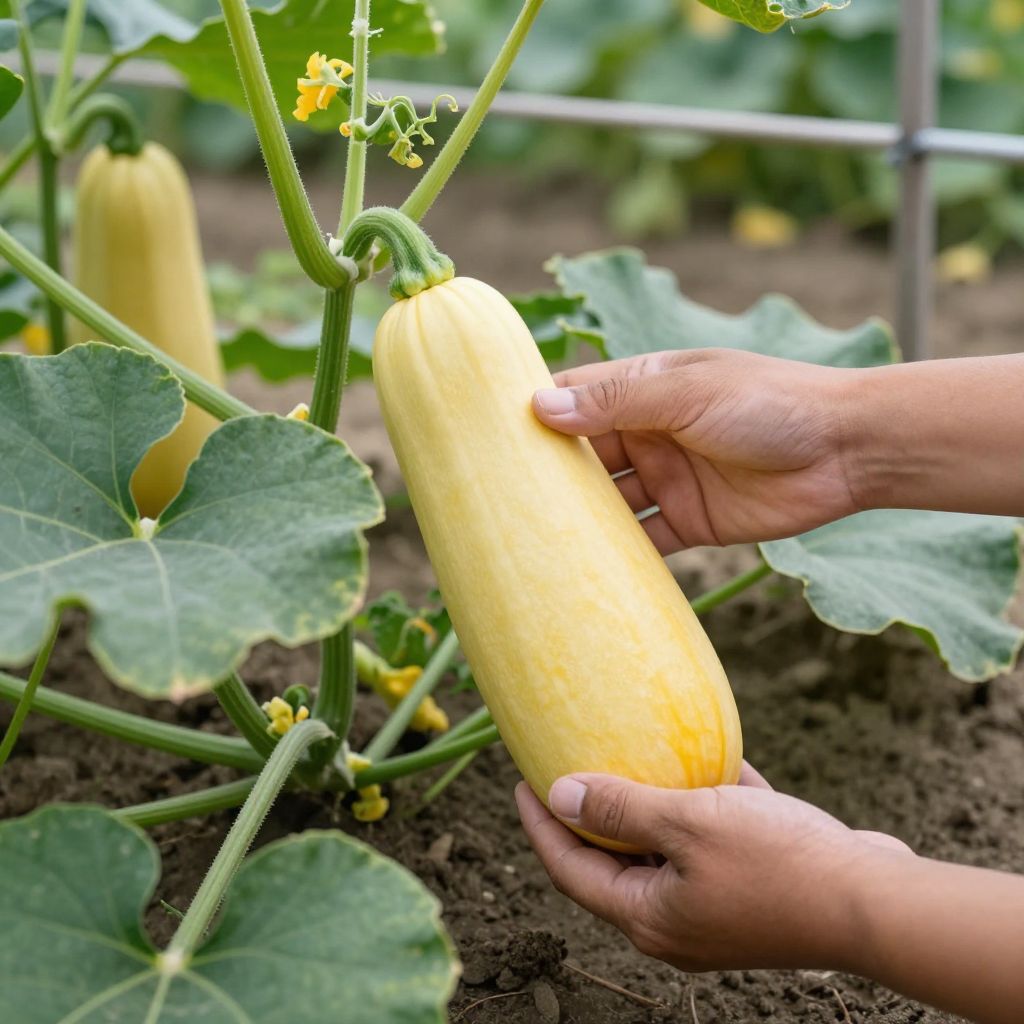
Wondering when to pick spaghetti squash before it gets too hard, too green, or starts rotting on the vine? The timing matters because spaghetti squash develops its best texture and storage life only after it has fully matured.
The good news is that the signs are easy to learn. Once you know what to look for on the vine, in the skin, and in the stem, you can harvest at the right stage and avoid underdeveloped or overripe fruit.
When to pick spaghetti squash?
Pick spaghetti squash when the rind is fully hardened, the skin has turned a deep yellow to golden color, and the stem begins to dry and cork over. Most fruits are ready about 80 to 100 days after planting, but the best indicator is maturity on the plant, not the calendar.
How to tell spaghetti squash is ready
Spaghetti squash gives several clear signals when it is ripe. Check more than one sign, because color alone can be misleading if the weather has been cool or your plant is still actively growing.
Look at the skin color and finish
- Ripe fruit usually turns deep yellow, golden yellow, or pale orange-yellow, depending on the variety.
- The skin should look dull rather than glossy.
- If the squash is still mostly green or has soft green patches, it likely needs more time.
Test the rind hardness
Press your fingernail into the skin. If it resists firmly and you cannot easily puncture it, the squash is close to harvest-ready. A soft rind means the fruit is still immature and will not store well.
Check the stem
A mature spaghetti squash usually has a stem that is dry, tough, and starting to brown or cork. The stem should feel firm, not green and tender. Do not pull fruit by the stem; cut it cleanly to avoid damage and decay.
Use the calendar as a guide, not the rule
Many spaghetti squash varieties mature in roughly 80 to 100 days from sowing, but local climate, soil fertility, and summer heat can shift that timing. Cooler regions and late starts often delay ripening, while warm, long seasons may speed it up.
What happens if you pick spaghetti squash too early?
Underripe spaghetti squash can still be edible, but the flesh is usually watery and stringy in a weak way rather than forming the firm, noodle-like strands people expect. It also stores poorly and may shrivel or rot sooner after harvest.
If frost is coming and the fruit is close to ready, you can pick it a little early and let it cure indoors. But if the rind is still soft and the fruit is very green, it may not finish developing well off the vine.
What happens if you leave it too long?
Overripe spaghetti squash can become dry, dull, and more prone to splitting or pest damage. In wet weather, mature fruit left on the ground too long may also start to deteriorate at the blossom end or where it touches damp soil.
Once the vines begin to decline and the fruit has reached full color and hard skin, it is usually better to harvest than to wait for perfection.
How to harvest spaghetti squash the right way
Harvesting carefully helps the squash store longer and reduces bruising. Use clean, sharp tools and handle the fruit gently.
- Choose a dry day if possible.
- Inspect the fruit for full color, hard skin, and a drying stem.
- Use pruning shears, loppers, or a sharp knife to cut the stem.
- Leave 1 to 2 inches of stem attached to the fruit.
- Set the squash down gently; do not drop or toss it.
Never twist or snap the squash off the vine. A broken stem creates an open wound that shortens storage life and invites rot.
Seasonal timing: when ripening usually happens
Spaghetti squash is a warm-season crop. It is planted after frost danger has passed and harvested in late summer through fall in many climates. The exact harvest window depends on when you planted and how long your growing season lasts.
In warm climates
Plants may set fruit early and continue ripening into fall. Watch for heat stress, because extreme temperatures can slow fruit development even when the vines look healthy.
In cooler climates
Fruit often needs the full season to mature. If frost threatens before the squash is ready, cover the vines lightly on cool nights if practical, or harvest slightly early and cure indoors if the fruit is nearly mature.
After first frost
A light frost may damage leaves and vines, but the fruit can sometimes still be harvested if the rind is already hard. If a hard freeze is expected, pick all mature or nearly mature squash immediately.
Growing conditions that help spaghetti squash mature on time
Healthy vines are more likely to produce fully ripened fruit before cold weather arrives. Good growing conditions also improve flavor and storage quality.
Sunlight
Give spaghetti squash full sun, ideally 6 to 8 hours or more each day. More sun usually means stronger vines and better fruit ripening.
Soil
Use fertile, well-drained soil rich in organic matter. Compost helps improve structure and moisture retention, especially in sandy or poor soils. Heavy clay should be loosened and amended so roots do not sit in stagnant water.
Watering
Water deeply and consistently, especially during flowering and fruit set. Irregular watering can cause poor fruit development, blossom-end issues, or stress that delays ripening. Try to keep the soil evenly moist, not soggy.
Mulch
A layer of straw, shredded leaves, or similar organic mulch helps conserve moisture and keep fruit cleaner. Keep mulch a little back from the base of the stems to reduce rot.
Common problems that affect harvest timing
Sometimes the question is not just when to pick spaghetti squash, but why the fruit is not ripening as expected. A few common issues can slow maturity.
Too much vine growth, not enough fruit ripening
If the plant has lush leaves but fruit stays small or pale, it may be getting too much nitrogen or too little sun. Excess nitrogen pushes leafy growth instead of fruit development.
Poor pollination
Squash flowers need pollination to form well-shaped fruit. If pollination is weak, fruit may be misshapen, abort early, or stop developing before full maturity. Hand-pollination can help in small gardens when bees are scarce.
Pests and disease
Squash bugs, cucumber beetles, and vine borers can weaken plants before fruit matures. Powdery mildew can also reduce leaf function, making it harder for the plant to finish ripening fruit.
- Remove heavily infested leaves when appropriate.
- Check stems and leaf undersides regularly.
- Keep plants spaced for airflow to reduce fungal problems.
- Rotate crops each year if possible to reduce recurring pest pressure.
Can spaghetti squash ripen after harvest?
Spaghetti squash can improve a little after picking if it is nearly mature, but it will not fully ripen like some fruits. What you can do is cure it in a warm, dry place for 1 to 2 weeks to toughen the skin and help it store better.
Keep cured squash in a cool, dry location with good airflow. Avoid damp basements or places where condensation forms, because moisture encourages rot.
Quick checklist before you harvest
- The skin is deep yellow or golden, not mostly green.
- The rind is hard and resists fingernail pressure.
- The stem is dry, corky, or browning.
- The fruit has reached typical maturity for the variety and season.
- Cold weather is approaching, or the plant is declining.
Final tip for getting the best harvest
If you are unsure, harvest one squash and test it rather than waiting for all of them. That gives you a real-world check on color, texture, and storage quality in your own garden conditions. For more harvest timing help, you may also find when to pick squash and when to harvest squash useful as you compare different types in the garden.