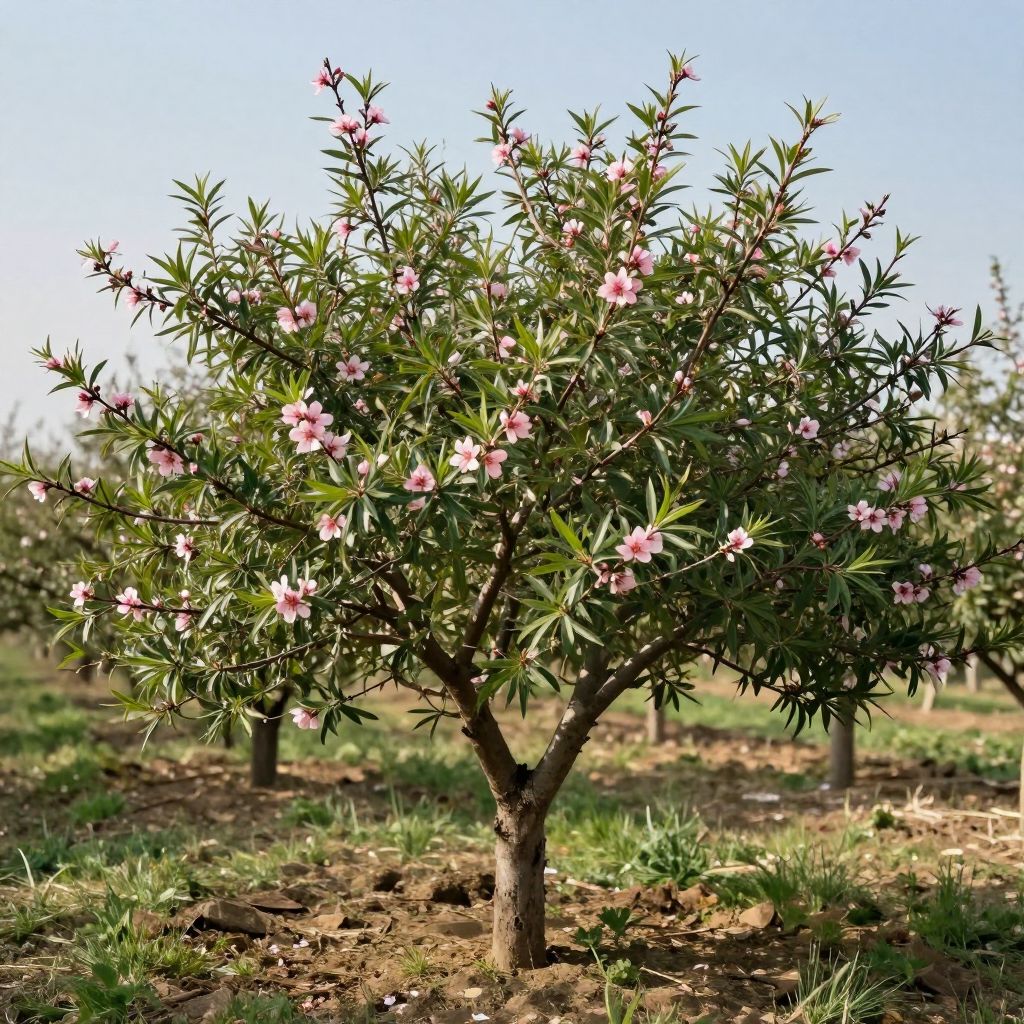
What does an almond tree look like? If you’re trying to identify one in a yard, orchard, or nursery, the answer is usually a small to medium deciduous tree with narrow, pointed leaves, pale pink to white spring blossoms, and a somewhat open, vase-shaped canopy.
It can resemble a peach or plum tree at first glance, but a few key details help you tell it apart. Once you know what to look for, almond trees are fairly easy to identify and even easier to grow well in the right conditions.
What does an almond tree look like?
An almond tree (Prunus dulcis) is a deciduous fruit tree with long, lance-shaped leaves, showy spring flowers, and a rounded to vase-shaped form. Mature trees are often 10 to 25 feet tall, though size depends on variety and pruning. The bark is gray-brown, and the tree usually has an airy, open look.
Key identifying features of an almond tree
Leaves
Almond leaves are typically narrow, pointed, and finely toothed along the edges. They are usually 2 to 5 inches long and medium green during the growing season.
Compared with many ornamental trees, the foliage looks lighter and less dense, especially on young or lightly pruned trees.
Flowers
One of the easiest ways to identify an almond tree is by its flowers. In early spring, before or as the leaves emerge, the tree produces five-petaled blossoms that are white to soft pink.
The flowers often appear in clusters along bare branches, creating a striking early-season display. This is a strong clue if you are trying to distinguish it from other stone fruit trees.
Fruit and hulls
After flowering, almond trees develop fuzzy green hulls that enclose the nut. As the season progresses, the hulls dry and split open, revealing the shell inside.
If the tree is growing in a home landscape, you may see ornamental fruiting or edible varieties. In either case, the outer hull is a useful identification feature.
Bark, branches, and shape
Young almond trees often have smooth gray bark, while older trees develop rougher bark and a more textured trunk. Branches can spread outward and upward, giving the tree a broad, open canopy.
The overall shape is often less dense than a shade tree, which helps sunlight reach the interior branches and fruiting wood.
How to tell an almond tree from similar trees
Almond trees are in the same genus as peaches, plums, cherries, and apricots, so they can look similar. The best way to identify them is to compare several traits at once rather than relying on just one feature.
- Peach trees often have similar leaves and flowers, but peach flowers are commonly deeper pink and the fruit is fleshy and fuzzy, not a dry hull around a nut.
- Plum trees usually have broader leaves and rounder fruit, and the flowers may be less open or less pink than almond blossoms.
- Apricot trees tend to have more rounded leaves and larger, more obvious fruit later in the season.
- Cherry trees often have smoother bark with horizontal lenticels and a different overall branching pattern.
If the tree has spring flowers, narrow leaves, and developing fuzzy hulls that split open, almond becomes a strong possibility.
Growing conditions almond trees prefer
If you are identifying an almond tree because you want to grow one, it helps to know what conditions it likes. Almond trees perform best in full sun, well-drained soil, and a climate with warm, dry summers. Poor drainage is one of the fastest ways to weaken or kill the tree.
Sunlight
Almond trees need full sun for healthy growth and good flowering. Choose a site that gets at least 6 to 8 hours of direct light daily, with more being better in cooler climates.
Soil
The tree prefers loose, fertile soil that drains well. Sandy loam is ideal, but many garden soils can work if they do not stay soggy after rain or irrigation.
If your soil is heavy clay, improve drainage before planting by selecting a better site, raising the planting area, or amending the soil carefully. Avoid planting into a low spot where water collects.
Climate
Almond trees need enough winter chill to flower well, but they are also sensitive to late frosts when blossoms are open. That means local climate matters a great deal.
In colder or wetter regions, the tree may struggle to produce a reliable crop even if it grows vegetatively. In very humid areas, fungal disease pressure can also be higher.
How to plant an almond tree
Planting correctly gives the tree the best chance to establish a strong root system. The main goal is to avoid compacted soil, standing water, and planting too deep.
- Choose a sunny, well-drained location with enough room for the mature canopy.
- Dig a hole only as deep as the root ball and about 2 to 3 times as wide.
- Loosen circling roots if the tree is container-grown.
- Set the tree so the root flare is at or slightly above soil level.
- Backfill with the native soil unless it is extremely poor; excessive amendment in the hole can create drainage problems.
- Water thoroughly to settle the soil.
- Mulch around the base with 2 to 4 inches of organic mulch, keeping it a few inches away from the trunk.
Do not bury the trunk flare. Planting too deep can lead to rot and weak growth over time.
Watering and feeding
Young almond trees need regular moisture while they establish, but they should not sit in wet soil. Deep, infrequent watering is usually better than frequent shallow watering once roots begin to spread.
The right schedule depends on your soil type, rainfall, heat, and tree age. In hot, dry weather, young trees may need more attention; in cool or rainy periods, they may need very little supplemental water.
Signs of watering trouble
- Too little water: wilting, leaf scorch, premature leaf drop, poor growth.
- Too much water: yellowing leaves, weak growth, persistently wet soil, root decline.
For feeding, use compost or a balanced fruit-tree fertilizer only if the tree shows it needs support or your soil is low in fertility. Overfertilizing can push soft growth that is more vulnerable to pests and frost damage.
Pruning almond trees
Pruning helps maintain shape, improve light penetration, and remove damaged wood. Almond trees are often trained to an open-center or vase-shaped form so sunlight can reach the interior branches.
Basic pruning goals
- Remove dead, broken, or crossing branches.
- Keep the center open for air and light.
- Limit overly upright growth that crowds the canopy.
- Maintain a manageable height for harvest and care.
Prune during the dormant season in drier weather when possible, and use clean, sharp tools. If your area has disease concerns, avoid pruning when conditions are wet, since fresh cuts can be more vulnerable.
Common pests and diseases
Almond trees can face the same issues as other stone fruit trees. The most common problems are often linked to stress, poor airflow, or excess moisture.
Pests
- Aphids can cluster on soft new growth and distort leaves.
- Mites may cause stippling or bronzing on foliage during hot, dry periods.
- Borers can weaken trunks or branches, especially stressed trees.
Diseases
- Blossom and brown rot may affect flowers, twigs, and fruit in damp conditions.
- Leaf spot and other fungal issues can appear when the canopy stays wet too long.
- Root rot is a risk in poorly drained soil.
Good spacing, pruning for airflow, and careful watering prevent many of these problems. Remove fallen debris, avoid wetting the foliage unnecessarily, and keep the tree healthy rather than relying on rescue treatments after damage is severe.
Propagation and harvest basics
Most home gardeners do not propagate almond trees from seed unless they are experimenting. Named varieties are usually propagated by grafting to preserve predictable fruit quality and tree size.
If you are growing almonds for harvest, remember that edible production depends on the variety, pollination, climate, and season. Some trees are self-fertile, while others need a compatible pollinator nearby. Check the tree’s specific requirements before expecting a crop.
When almonds are ready
Harvest timing varies by climate and variety, but the general sign is that the hulls begin to split and dry. Nuts are usually collected once the hulls open and the shells mature.
If you are unsure, wait until the tree clearly shows mature nut development rather than picking too early. Premature harvest can reduce quality and storage life.
Landscape uses and maintenance tips
Almond trees can work well as productive specimen trees in sunny yards, especially where winter chill and summer dryness suit them. They also add ornamental value in spring when they bloom before many other trees leaf out.
To keep the tree looking its best:
- Mulch to conserve moisture and suppress weeds.
- Keep grass competition away from the trunk.
- Inspect regularly for dead wood, pests, and cankered branches.
- Prune lightly and consistently rather than letting the canopy become crowded.
One of the most common mistakes is treating an almond tree like a general shade tree. It needs sun, drainage, and seasonal attention to stay vigorous.
Quick identification checklist
If you are standing in front of a tree and wondering, “What does an almond tree look like?”, use this simple checklist:
- Deciduous tree with an open, vase-shaped form
- Narrow, pointed, finely toothed leaves
- White to pale pink blossoms in early spring
- Fuzzy green hulls that later split open
- Gray-brown bark that becomes rougher with age
If most of these traits match, you are likely looking at an almond tree or a very close relative in the Prunus group.
For more help identifying trees in your yard, you may also find this guide useful: what type of tree is this?