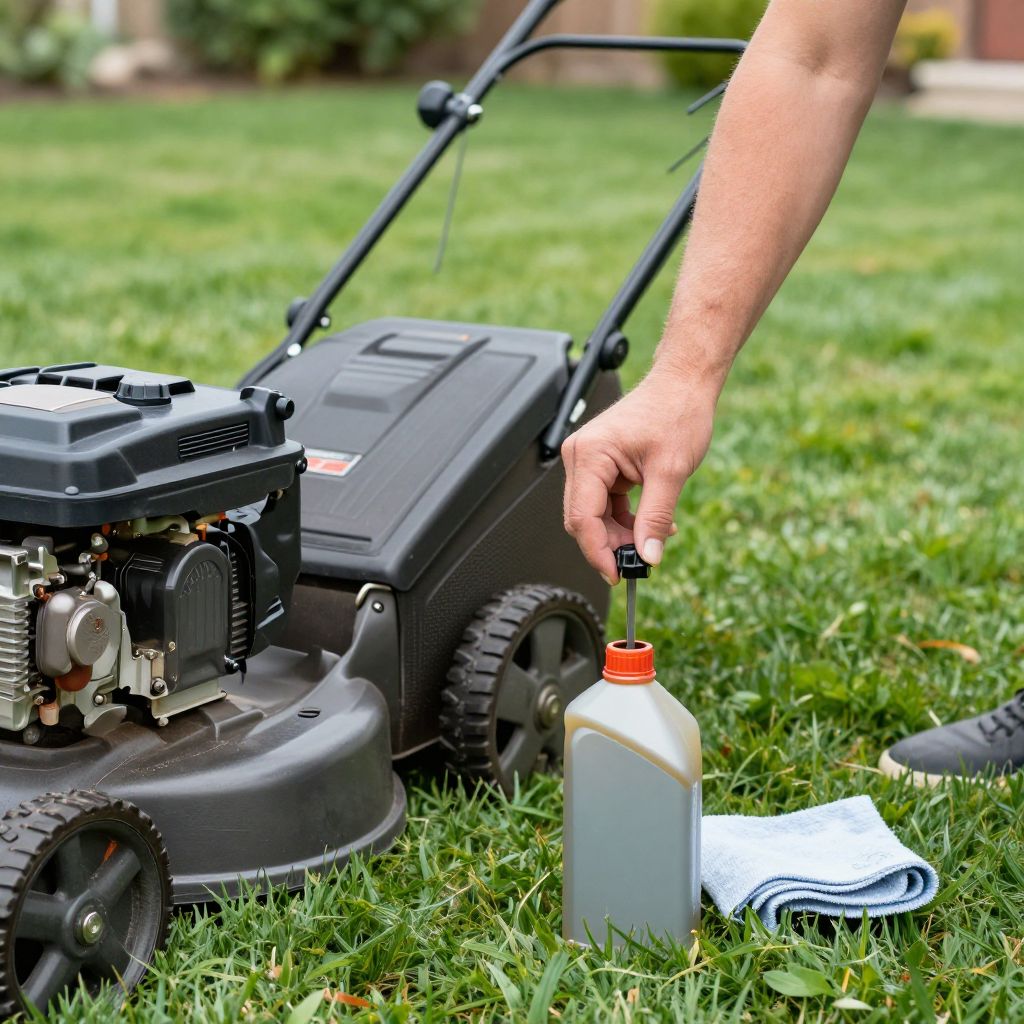
What kind of oil goes in a lawn mower? The short answer is: use the oil grade listed in your mower’s owner’s manual, because the right choice depends on the engine type, your climate, and whether the mower is a 4-stroke or 2-stroke model. For most modern walk-behind mowers, that means a small-engine oil such as SAE 30, 10W-30, or 5W-30.
Using the wrong oil can make starting harder, increase wear, or cause poor performance in hot or cold weather. A few minutes spent checking the manual and the oil level can help your mower run smoothly all season.
What kind of oil goes in a lawn mower?
Most lawn mowers use 4-stroke small-engine oil, commonly SAE 30 in warm weather or a multigrade oil like 10W-30 or 5W-30 in cooler conditions. Always confirm the exact recommendation in your mower’s manual, because some engines specify a different viscosity, and 2-stroke mowers require oil mixed with fuel instead of crankcase oil.
First: identify your mower engine
Before you pour anything in, check whether your mower is a 4-stroke or 2-stroke machine. This matters because the oil system is completely different.
4-stroke mower engines
These are the most common on push mowers, self-propelled mowers, and many riding mowers. The oil goes into a separate crankcase, usually through a dipstick/fill cap.
2-stroke mower engines
These are less common in modern lawn mowers but may appear in some older or specialty machines. They do not have a separate oil reservoir; instead, oil is mixed with gasoline at the ratio specified by the manufacturer.
How to check quickly
- Look for a dipstick or oil fill cap on the engine.
- Read the model label and owner’s manual.
- Check whether the fuel tank has any note about oil mixing.
- If you are unsure, do not guess—verify the engine type first.
Choosing the right oil viscosity
Oil viscosity describes how thick or thin the oil is at different temperatures. For lawn mowers, the best choice usually depends on the season and your local climate.
Common lawn mower oil grades
- SAE 30 – A common choice for warm-weather mowing and many small engines.
- 10W-30 – Useful for a wider temperature range, especially where spring and fall mornings are cool.
- 5W-30 – Often recommended for cooler climates or early-season mowing.
How climate affects your choice
In hot weather, thicker oil can help maintain protection when the engine is working hard. In cooler weather, a multigrade oil may flow more easily at startup, which can reduce wear and make starting easier.
If your manual gives a temperature chart, follow it. If it does not, a quality small-engine oil in the recommended viscosity range is usually the safest choice.
Can you use car oil in a lawn mower?
Sometimes, but not always. Some mowers can use standard automotive oil if it matches the required viscosity and meets the engine manufacturer’s specifications. However, oil made for small engines is often a better fit because it is formulated for the higher operating demands and simpler lubrication systems of mower engines.
When car oil may be acceptable
- The mower manual explicitly allows it.
- The viscosity matches the recommendation.
- The oil is clean and appropriate for gasoline engines.
When to avoid it
- If the manual says to use small-engine oil only.
- If the oil is too thin or too thick for the season.
- If the mower is a 2-stroke engine, which needs fuel mix oil instead.
Important: Never use diesel engine oil, hydraulic oil, or random household lubricants in a lawn mower engine. They are not substitutes for the correct engine oil.
How to check and change lawn mower oil
Regular oil checks are one of the easiest ways to extend the life of a mower. Dirty or low oil can lead to overheating, poor lubrication, and engine damage.
Step-by-step oil check
- Park the mower on level ground.
- Turn off the engine and let it cool.
- Remove the dipstick or oil cap.
- Wipe it clean, reinsert it, then check the level again.
- Make sure the oil sits within the marked range.
Basic oil-change steps for a 4-stroke mower
- Run the engine briefly so the oil drains more easily, then shut it off and cool slightly.
- Disconnect the spark plug wire for safety.
- Drain the old oil into a suitable container.
- Refill with the correct type and amount of oil from the manual.
- Check the dipstick, then run the engine briefly and recheck the level.
Do not overfill. Too much oil can cause smoking, fouled spark plugs, and messy leaks.
How much oil does a lawn mower take?
The amount varies by engine size and design, so the manual is the best source. Small walk-behind mowers often take less than a quart, while larger riding mowers may take more. Always add oil gradually and check the dipstick rather than pouring in the full amount at once.
Why the exact amount matters
Underfilling can starve the engine of lubrication, while overfilling can cause crankcase pressure problems. Either one can shorten engine life.
Signs you may be using the wrong oil
If your mower is hard to start, smokes excessively, or runs roughly after an oil change, the oil type or level may be wrong. These symptoms can also point to other maintenance issues, so check the basics first.
Common warning signs
- Blue or white smoke from the exhaust
- Oil leaking from the air filter or muffler area
- Hard starting after storage
- Engine bogging down under normal load
- Oil level rising unexpectedly, which can indicate fuel contamination
Practical fixes
- Drain and replace oil if it looks dirty, watery, or smells like gasoline.
- Confirm the oil viscosity matches the season.
- Replace a dirty air filter, which can mimic engine trouble.
- Check the spark plug if the engine still runs poorly.
Seasonal maintenance tips for mower oil
Mower oil needs change with the seasons, especially if you store your mower for winter or use it in a variable climate. A little attention before and after the mowing season can prevent spring startup problems.
Before the mowing season
- Check the oil level before the first cut.
- Change old oil if it looks dark, dirty, or contaminated.
- Inspect for leaks around the drain plug and seals.
During the season
- Check oil regularly, especially before long mowing sessions.
- Top off only with the same oil type already in the engine, unless you are doing a full oil change.
- Keep the mower clean so grass buildup does not trap heat around the engine.
Before storage
Change the oil if the manual recommends it, especially if the old oil contains moisture, dirt, or fuel residue. Clean oil helps reduce corrosion during storage.
Common mistakes to avoid
Many mower problems come from simple maintenance errors rather than major engine failures. Avoid these common mistakes to keep your machine running well.
- Using the wrong viscosity for the temperature or engine type.
- Mixing 2-stroke and 4-stroke systems by adding oil where it does not belong.
- Overfilling the crankcase beyond the dipstick mark.
- Ignoring old oil that has become dirty or diluted with fuel.
- Skipping the manual when the engine has special requirements.
Quick buying guide for lawn mower oil
When you are standing in the garden center or hardware store, look for oil labeled for small engines or lawn mowers. Choose the viscosity that matches your climate and the engine manufacturer’s recommendation.
What to look for on the bottle
- SAE 30, 10W-30, or 5W-30 if your manual allows it
- Small-engine or 4-cycle engine labeling
- Clear viscosity information
- Fresh, sealed packaging
If you already have oil at home, check the label carefully before using it. A correct viscosity is useful only if it also suits the mower’s engine design.
Final takeaways
For most lawn mowers, the right answer to what kind of oil goes in a lawn mower is the oil specified by the manual, usually SAE 30 or a multigrade like 10W-30 or 5W-30 for 4-stroke engines. The safest habit is to verify the engine type, match the viscosity to your climate, and check the oil level regularly.
Before your next mow, take two minutes to inspect the dipstick and confirm the oil grade. If you want more practical lawn care help, it’s also worth reading up on basic lawn mower maintenance and how to sharpen mower blades so your equipment stays reliable all season.