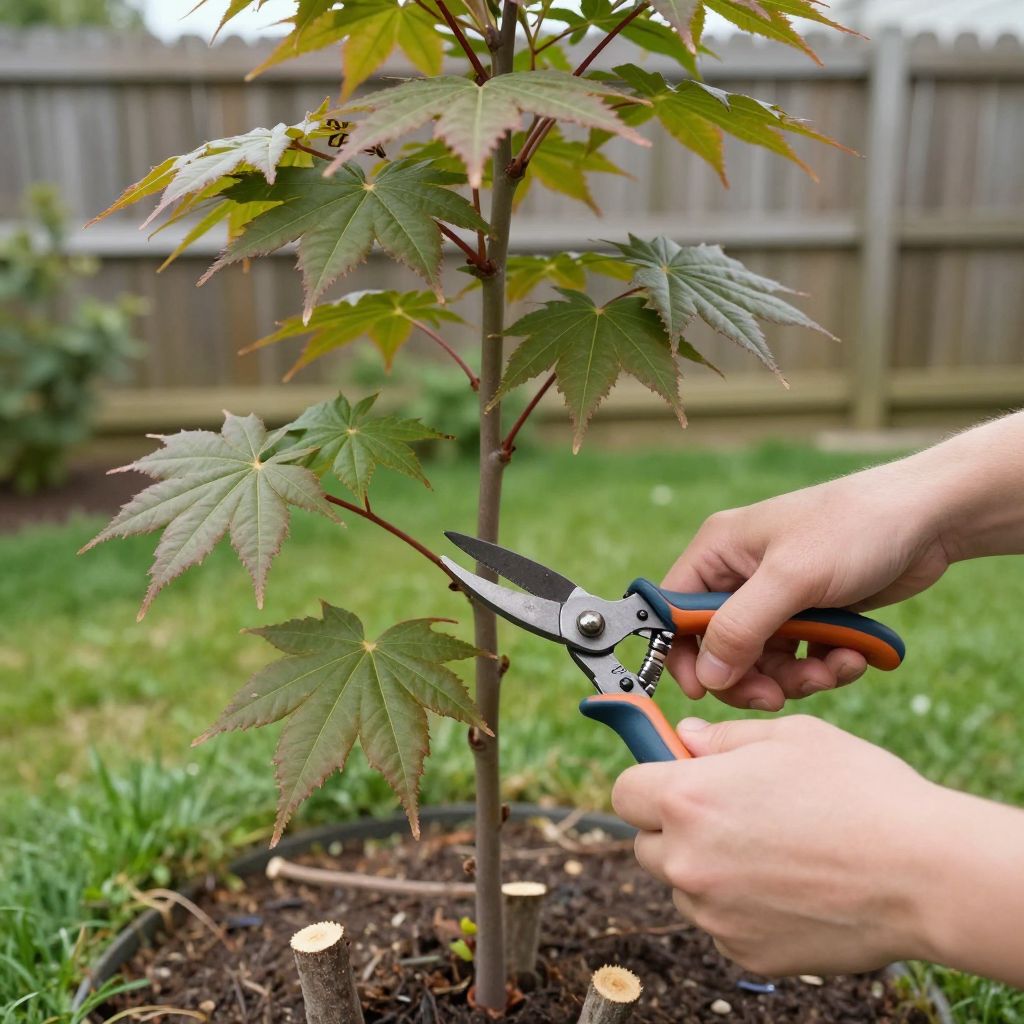
If you’re wondering when to prune maple trees, timing matters more than most gardeners realize. Maples can bleed sap heavily when cut at the wrong time, and while that sap loss usually doesn’t kill a healthy tree, it can be messy and stressful for the plant.
The safest time to prune most maples is during late summer, after the leaves have fully expanded and the tree’s spring sap flow has slowed. Light pruning can also be done in midwinter in some climates, but avoid major pruning in early spring when maples are actively “bleeding.”
When to prune maple trees?
The best time to prune maple trees is usually in late summer, from mid- to late summer depending on your climate, when the tree is in full leaf and sap flow is lower. This timing reduces bleeding from cuts and lets you see the branch structure clearly. Avoid heavy pruning in early spring, when maples are most likely to bleed sap.
Why timing matters for maples
Maples are known for heavy sap flow in late winter and early spring. If you prune during that period, cut surfaces may drip for days or even longer.
That bleeding is usually more of a nuisance than a serious injury, but repeated or unnecessary pruning can weaken the tree, invite pests, and create larger wounds than needed.
What happens if you prune at the wrong time?
- Heavy sap bleeding from fresh cuts in late winter or spring.
- More stress on the tree if large limbs are removed unnecessarily.
- Greater risk of poor pruning cuts when the tree is leafless and structure is harder to judge.
- Potential entry points for disease if tools are dirty or cuts are ragged.
Best seasons for pruning maple trees
Late summer: the safest general window
For most home gardeners, late summer is the best answer to when to prune maple trees. By then, the tree has finished its spring growth flush, and pruning wounds are less likely to bleed heavily.
This is also the easiest time to see which branches are crossing, crowded, or growing in the wrong direction because the canopy is fully visible.
Midwinter: sometimes acceptable for light pruning
In colder climates, very light pruning can be done in midwinter when the tree is fully dormant. This is often acceptable for removing dead, broken, or obviously hazardous branches.
Still, if you can wait, late summer is usually the better choice for routine shaping and thinning.
Early spring: usually avoid
Early spring is the time to avoid for most maple pruning. As temperatures rise and sap begins moving, cuts can bleed heavily.
If a branch is dangerous or broken, remove it when needed, but keep the cut as small and clean as possible.
How much can you prune at one time?
Maples respond best to light, selective pruning. A good rule is to remove only what is necessary to improve structure, safety, or health.
For mature trees, avoid removing large amounts of canopy at once. Heavy topping or severe reduction cuts can create weak regrowth and long-term problems.
Good reasons to prune
- Dead, damaged, or diseased branches
- Crossing or rubbing limbs
- Low branches blocking walkways or driveways
- Competing leaders on young trees
- Branches growing toward the trunk or into crowded areas
Reasons to leave the tree alone
- The tree is healthy and has a natural, balanced shape
- You are tempted to remove too much at once
- The tree is very large and work would require risky climbing
- It’s the wrong season and the pruning is not urgent
How to prune a maple tree correctly
Use clean, sharp tools and make careful cuts just outside the branch collar, the slightly swollen area where the branch joins the trunk or larger limb. Do not cut flush against the trunk.
Proper cuts help the tree close wounds more effectively and reduce the chance of tearing.
- Start with the 3 D’s: remove dead, damaged, and diseased wood first.
- Step back and look for branches that rub, cross, or grow inward.
- Remove one branch at a time so you can keep the canopy balanced.
- Cut small branches cleanly with hand pruners or loppers.
- For larger limbs, use the three-cut method to prevent bark tearing.
The three-cut method for larger branches
- Make a shallow undercut a short distance from the trunk.
- Make a second cut from the top, farther out, to remove most of the branch’s weight.
- Make the final cut just outside the branch collar to finish cleanly.
This method is especially helpful when pruning branches larger than about 1 inch thick, because it reduces bark stripping.
Pruning young maples vs. mature maples
Young maples
Young trees benefit from light structural pruning. The goal is to build a strong framework, not to force a shape.
- Choose a single central leader if the species and form call for it.
- Remove competing stems early.
- Space scaffold branches so they are well distributed around the trunk.
- Correct narrow branch angles before they become weak joints.
Mature maples
Mature trees should be pruned conservatively. Focus on safety, clearance, and removing problem wood rather than changing the tree’s overall shape.
If a mature maple needs major work, it is often best to spread pruning over several seasons rather than removing too much at once.
Common mistakes to avoid
- Pruning in early spring unless the work is urgent.
- Topping the tree, which creates weak, fast-growing shoots.
- Removing too many large limbs in one season.
- Leaving stubs, which can die back and slow healing.
- Using dull or dirty tools that crush tissue or spread disease.
- Climbing unsafely or overreaching with pruning tools.
What if your maple is bleeding sap?
If you prune at the wrong time and the tree bleeds sap, don’t panic. In most cases, the bleeding stops on its own as the weather changes and the tree settles back into growth.
Do not try to seal the wound with paint or wound dressing unless a local arborist specifically recommends it for a special situation. In most cases, the tree does better with a clean cut and no coating.
Signs your maple needs professional help
Some pruning jobs are better left to a certified arborist, especially if the tree is large or the branches are near power lines.
- Large limbs overhanging roofs, driveways, or walkways
- Visible trunk decay, cavities, or major cracks
- Multiple co-dominant stems with weak attachments
- Branches high in the canopy that require climbing
- Storm damage involving split or hanging limbs
If the tree is valuable or mature, professional pruning can help preserve its structure and reduce future risk.
Aftercare following pruning
Most maples do not need special treatment after light pruning, but a few simple steps help them recover well.
- Water deeply during dry spells, especially for younger trees.
- Keep mulch a few inches away from the trunk, not piled against it.
- Watch for new suckers or vigorous shoots after heavier pruning.
- Inspect cuts over the next season for dieback or unusual discoloration.
Healthy soil, steady moisture, and minimal stress help a maple recover faster than extra products ever will.
Quick pruning checklist for maple trees
- Wait for late summer if you can.
- Remove dead, damaged, and diseased branches first.
- Use clean, sharp tools.
- Make cuts just outside the branch collar.
- Avoid heavy pruning in early spring.
- Do not top the tree.
- Call a professional for large or risky work.
Conclusion
When to prune maple trees comes down to one simple rule: choose late summer for most routine pruning, and avoid early spring whenever possible. If you keep cuts light, use proper pruning technique, and remove only what the tree truly needs, your maple will stay healthier and look better for years.
If you want to keep improving your tree care skills, consider reading more about proper pruning tools, young tree training, and seasonal maintenance for shade trees.